
Reviewed · SHIBUYA EXPERIENCES
Tokyo: Akihabara, Shibuya, Karaoke & City Lights Night Tour
Neon waits after the last train sound. This guided Tokyo night route strings together Ueno, Akihabara, and the photo-at-night hits of Shibuya and Shinjuku, then ends with karaoke.
I especially like the mix of pacing. You get a calm start at Ueno Park for cherry blossoms if they’re in season, then you shift gears to Akihabara’s electronics and anime world with real free time to browse.
One thing to consider: it’s not a smooth, stop-every-five-minutes kind of night. You’ll be on your feet in areas like Kabukichō, and it’s not suitable for wheelchair users.
In This Review
- Key things I’d plan around
- How the Tokyo Night Route Really Works (and why it’s good value)
- Meeting at Ueno: the Seven Eleven by the pandas
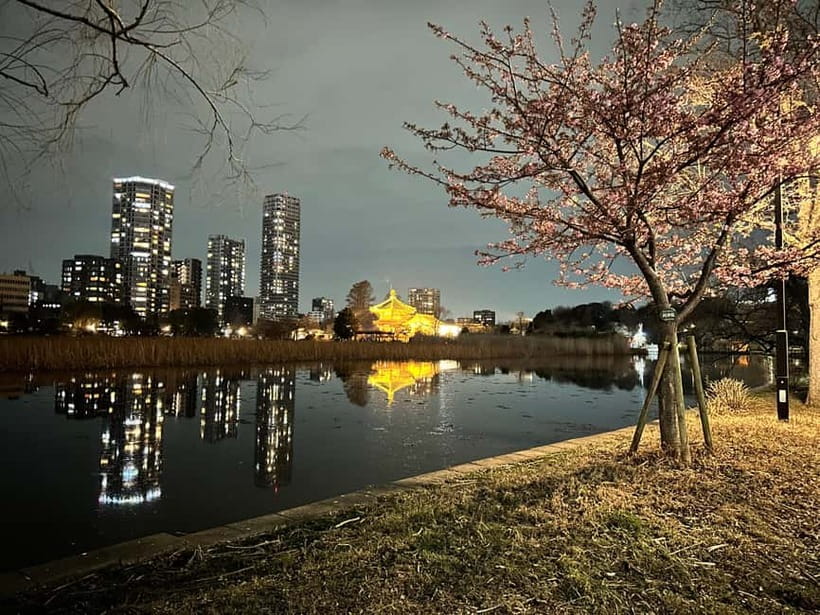
- Ueno Park at dusk: cherry blossoms and a calmer start
- Akihabara after dark: electronics, anime culture, and real free time
- Shibuya Crossing at night: the photo moment that actually delivers
- Shinjuku and Kabukichō: walking the entertainment district lights
- Karaoke in Shinjuku: the included sing-along that turns the night into a story
- Price and logistics: does $79 feel fair?
- What kind of traveler should book this?
- A few practical tips that will save your night
- Should you book the Tokyo Akihabara, Shibuya, Karaoke, City Lights night tour?
- FAQ
- What places are included on the tour?
- What language is the guide?
- Are train tickets included?
- Is karaoke included in the price?
- Are snacks and drinks included?
- Where is the meeting point?
- What time should I arrive?
- What should I bring?
- Is the tour wheelchair accessible?
- Can I pay later?
- What is the cancellation policy?
Key things I’d plan around
- Ueno Park stroll at dusk with a cherry blossom moment if the timing is right
- Akihabara free time to explore electronics shops, themed cafés, and anime memorabilia
- Shibuya Crossing photos where you can actually step back and frame the crowd
- Kabukichō walking night energy around Shinjuku’s entertainment district
- Shinjuku karaoke included with a fun, low-pressure group vibe
How the Tokyo Night Route Really Works (and why it’s good value)
This is the kind of Tokyo night tour that makes sense when you want “the big scenes” without spending your entire evening figuring out trains, meeting points, and where to stand for photos.
For $79 per person, the value isn’t just that you’re paying for guidance. The tour also includes train tickets between the stops, plus the karaoke entrance fee. That matters in Tokyo, where transit can add up fast and karaoke prices can feel random if you’re booking on your own.
You’ll start around Ueno Station and move through Akihabara, Shibuya, and Shinjuku. The order is smart: quieter first, then more electric as the night grows louder. It also helps you see Tokyo’s different moods instead of repeating the same type of street twice.
More booked around Shibuya Crossing
- Official Street Go-Kart in Shibuya
★ 5.0 · 3,435 reviews - Tokyo: Street Kart Experience in Shibuya
★ 4.9 · 1,484 reviews - Shibuya Meltdown Nightlife Tour: All-You-Can-Drink Bar Hopping
★ 5.0 · 1,058 reviews - Shibuya Official Street Go-Kart in Shibuya Annex
★ 5.0 · 972 reviews
Meeting at Ueno: the Seven Eleven by the pandas
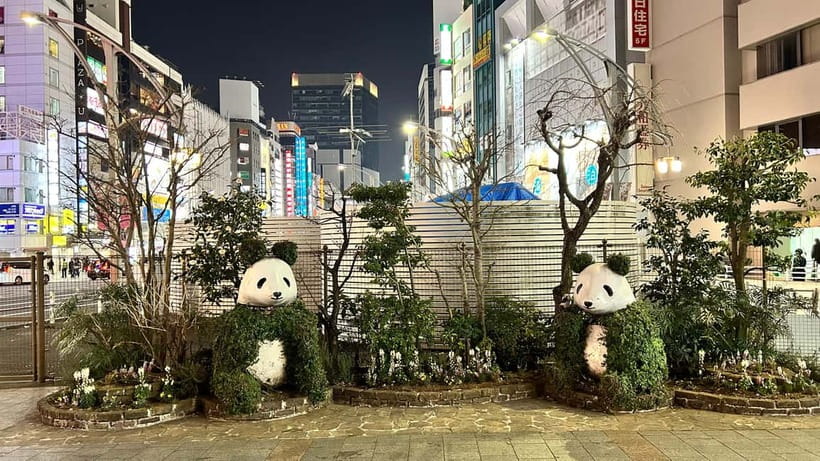
The meeting point is easy once you know it: meet your guide at the Seven Eleven next to the pandas, at Ueno Station. Use Exit C7. Your guide will be holding a sign for Amigo Tours Japan.
Plan to arrive at least 10 minutes early for check-in. At night, that buffer time keeps you from stress-walking in the wrong direction, especially in Ueno where station entrances can be confusing when you’re tired.
If you’re traveling with a charged smartphone, you’ll be fine. This tour doesn’t ask you to carry a lot. It asks you to stay ready to walk, shoot photos, and move when the group moves.
Ueno Park at dusk: cherry blossoms and a calmer start
Ueno Park is the opening act, and I like that. Instead of jumping straight into neon streets, you begin with a slower scene where the mood is more reflective.
Your guide leads you along the pathways as dusk settles. The highlight here is simple: admire the cherry blossoms. Even if you’re not there in peak bloom, Ueno Park at night still gives you that “Tokyo has quiet corners too” feeling before the city turns loud.
What makes this stop useful on a night tour is contrast. You’re not just collecting places. You’re learning what changes when day flips to evening: light temperatures, street sounds, and how crowded areas feel when the sky darkens.
Practical note: wear comfortable shoes. Parks don’t look far on a map, but you can still rack up steps before you even reach Akihabara.
Akihabara after dark: electronics, anime culture, and real free time
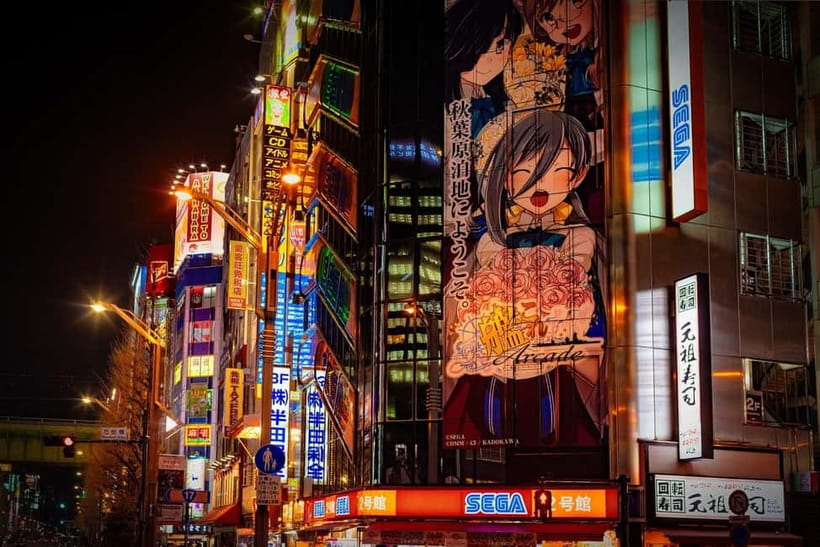
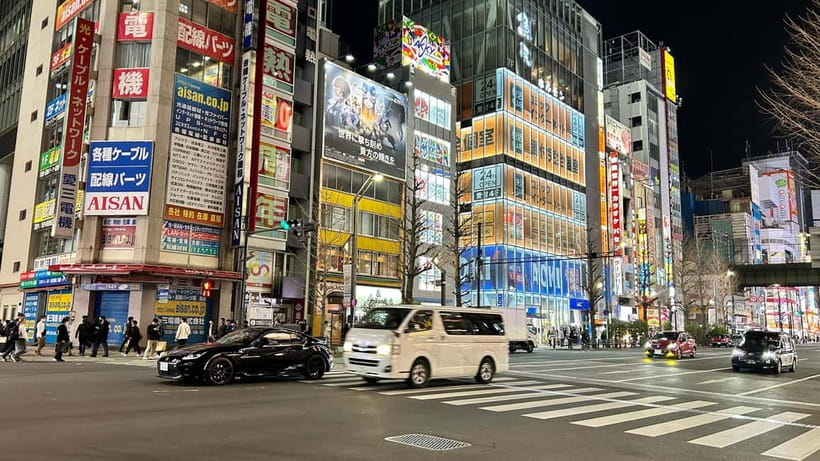
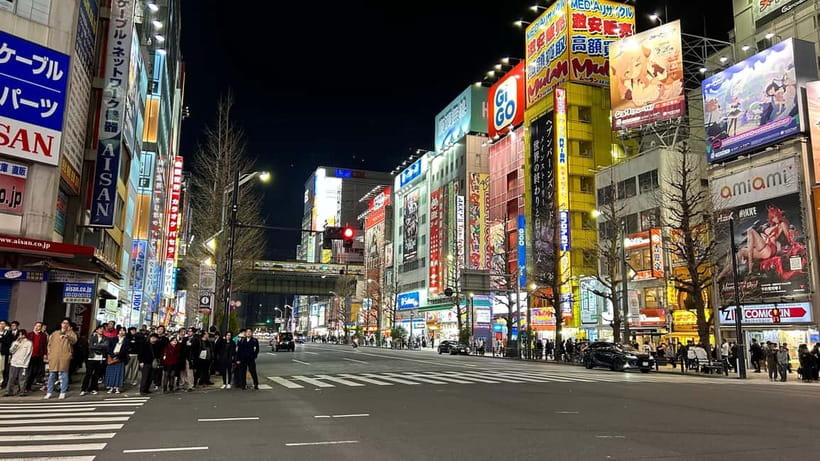
Next comes Akihabara, the district that practically introduced the rest of the world to the idea of tech-and-anime tourism. Your guide gives you a brief overview of the area’s history and why it became a hub for electronics, anime, and video games.
Then you get free time, and that’s a big deal. This isn’t a “walk past storefronts at speed” stop. You can browse electronics shops, check out themed café options if that’s your thing, and hunt for unique anime-related memorabilia.
I like the freedom here because Akihabara has different personalities depending on what you like:
- If you’re into gadgets, you’ll want time to compare devices and shop-style displays.
- If you’re into anime, you’ll want time to look closely at merchandise racks and themed details.
- If you just love the visual chaos, you’ll still benefit from slowing down and letting the street soak in.
There’s also a language angle. This tour runs in English and Spanish, and that helps a lot if you don’t want to translate every sign alone while you’re trying to enjoy the atmosphere.
Shibuya Crossing at night: the photo moment that actually delivers
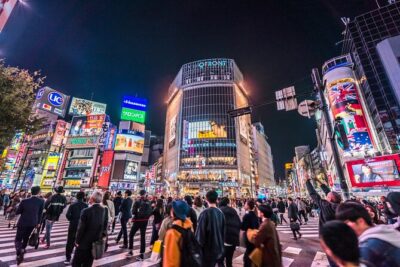
Then you move to Shibuya, and you’re there for one reason: Shibuya Crossing.
This is one of those places where pictures can look great but don’t fully explain the experience. On the ground, the scale is different. Thousands of people cross at the same time, and it’s loud with motion. Your guide gives you a moment to take fantastic photos and soak in the energy without you needing to guess the best angles.
What I’d do during your photo time: don’t just shoot straight on. Try a few perspectives if the group allows it—some shots look better from the sidewalk side streets, and others are better from the edge where you can see multiple streams of pedestrians.
Also, Shibuya at night is where Tokyo’s “street design meets crowd choreography” becomes obvious. It’s not only neon. It’s how the city moves people.
More of Akihabara, ranked by our reviewers
- Official Street Go-Kart Tour – Akihabara★ 5.0 · 1,578 reviews
- Akihabara Anime & Game Adventure Walking Tour (Group or Private)★ 5.0 · 404 reviews
- Tokyo: Gameboy Mod Workshop at Akihabara★ 5.0 · 253 reviews
- Akihabara: Private Anime and Pop Culture Tour★ 4.8 · 152 reviews
- Akihabara Tailor-made Private Tour for Anime Fans★ 5.0 · 142 reviews
Shinjuku and Kabukichō: walking the entertainment district lights
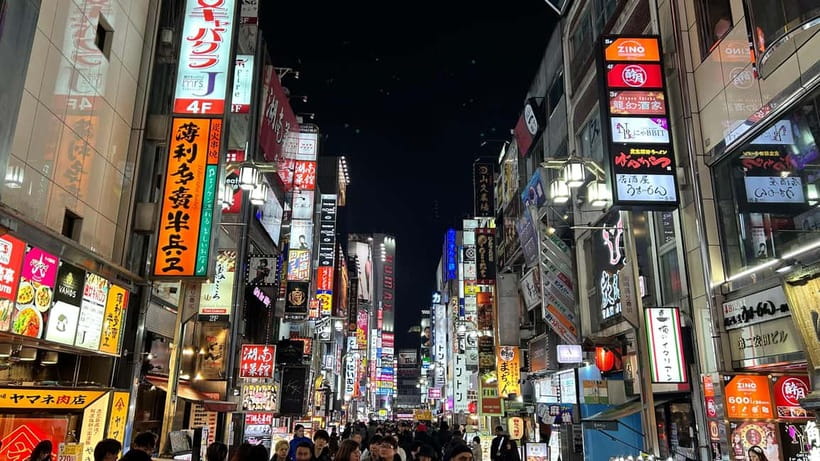
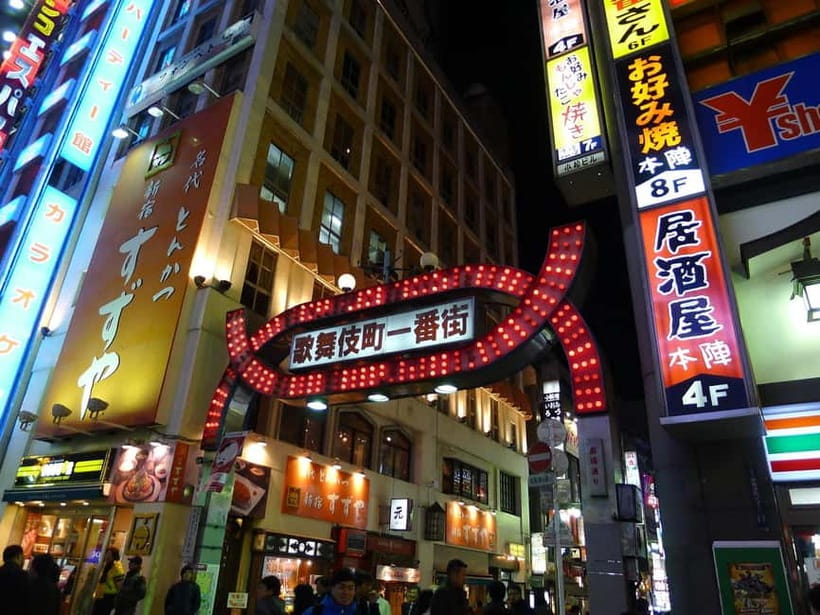
The final stop is Shinjuku, and the tour takes you walking through Kabukichō, Shinjuku’s famous entertainment district.
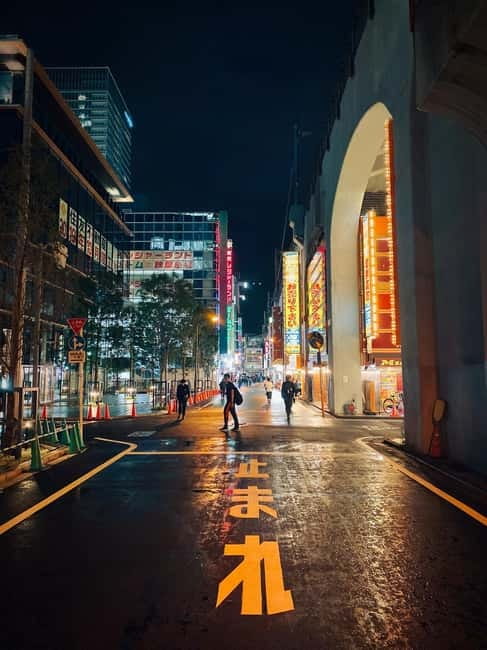
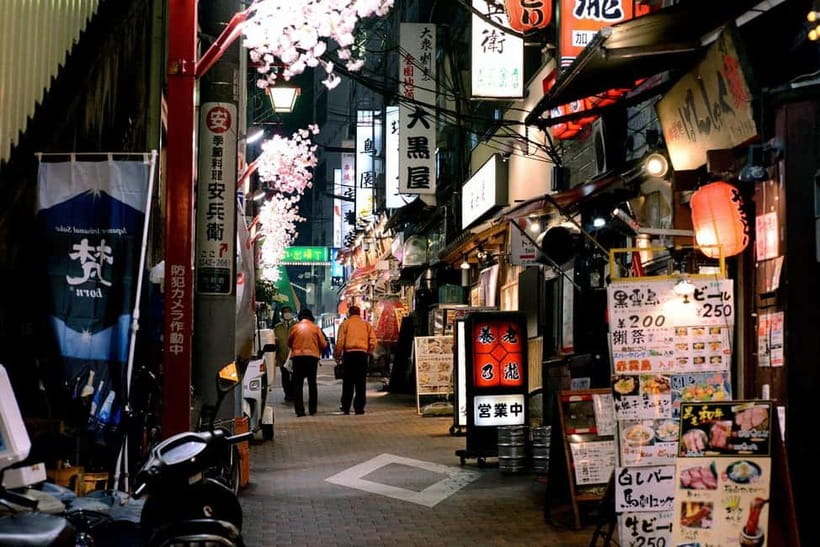
If you want Tokyo nightlife that feels like a world of its own, Kabukichō delivers. Expect bright signs, packed streets, and lots of energy. This isn’t a quiet “scenic view” moment. It’s about experiencing the area as it lives after dark.
A walking tour here makes sense because the district is built for wandering—if you try to “do it” too fast on your own, you might miss the smaller streets that make the neighborhood feel real.
This is also where your guide helps you keep the night organized. You don’t have to worry about constantly checking maps while people are flowing around you.
Karaoke in Shinjuku: the included sing-along that turns the night into a story
At the end, you get to karaoke at a venue in Shinjuku. The karaoke entrance fee is included, so you’re not doing the awkward math at the door.
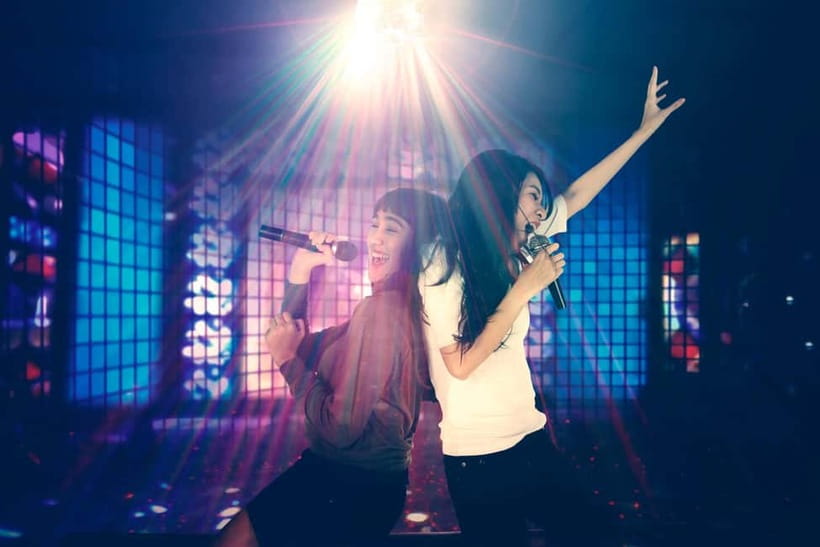
This part is usually the emotional peak of the evening. One group described a karaoke setup with a private room, lighting that made the space feel special, comfy seating, and lots of songs to choose from. Another highlight: by the second song, everyone was singing with serious laughter energy.
Even if you’re not a confident singer, it still works. Karaoke in Japan isn’t only about being great at singing. It’s about sharing the fun, keeping the room lively, and joining a group moment you’ll remember later.
Bring the simplest thing: a willingness to be a little silly. Tokyo nights are for that.
Price and logistics: does $79 feel fair?
Let’s talk value directly.
You’re paying $79 per person for:
- A bilingual guide in English and Spanish
- Train tickets for transfers between the itinerary points
- Karaoke entrance fee
- Snacks and drinks only if you pick the option that includes them
So where does the money go? Guidance and planning, plus the karaoke admission, plus the transit between major districts. Those are the parts that are annoying to DIY at night, especially when you want Akihabara + Shibuya + Shinjuku in one run.
If you’d otherwise book karaoke separately, you’re basically already using your money efficiently by bundling it. If you also like having snacks and drinks handled, pick the option that includes them.
Potential drawback on cost: if you don’t choose the snacks option, you’ll need to budget food and drinks on your own during the evening. Plan a small plan so you don’t end up hungry at karaoke time.
What kind of traveler should book this?
This tour fits best if you want:
- A night plan that hits several iconic districts without stress
- Time for browsing in Akihabara, not only photo stops
- Karaoke as an activity, not a last-minute decision
- A guide who can explain things in English or Spanish
It may be less ideal if you:
- Need wheelchair-friendly access (it’s not suitable for wheelchair users)
- Want a very quiet evening with minimal walking
- Are hoping for a long sit-down meal focus (food isn’t included unless you choose the snacks/drinks option)
If you’re traveling solo, this can also be a relief because you’re not wandering alone through crowded spots like Shibuya Crossing and Kabukichō.
A few practical tips that will save your night
Here’s what will make your experience smoother:
- Wear comfortable shoes. You’ll be walking through multiple districts, including Kabukichō.
- Bring a camera and a charged smartphone. This tour is built around photo moments.
- Keep your energy for the whole arc. The night starts calmer (Ueno) and ends loud (karaoke).
- If cherry blossoms matter to you, double-check timing before you go. The tour highlight is cherry blossoms in Ueno Park, but nature decides the exact bloom schedule.
- If you’re Spanish-speaking, you’ll likely appreciate the guide language availability. Some guide names you may encounter in past groups include Ethan, Erik, Pastor, Oliver, Hiro, and Erick, and they’ve been described as helpful and not rushed.
Should you book the Tokyo Akihabara, Shibuya, Karaoke, City Lights night tour?
I’d book it if you want a high-impact Tokyo night that mixes iconic sights with hands-on fun. Ueno Park gives you a softer start, Akihabara gives you time to browse on your own terms, Shibuya Crossing gives you a serious photo moment, and karaoke turns the whole evening into something social and memorable.
I’d skip (or consider a different format) if you’re looking for wheelchair-friendly access or you’d rather spend more time eating and less time walking. Also, if you’re very sensitive to crowds, plan your expectations for Shibuya Crossing and Kabukichō.
If your goal is a well-paced night plan that’s easy to follow and includes karaoke and transit, this one checks the boxes.
FAQ
What places are included on the tour?
The tour includes stops around Ueno Park, Akihabara, Shibuya Crossing, and Shinjuku, plus a karaoke experience in Shinjuku.
What language is the guide?
The tour offers a bilingual guide in English and Spanish.
Are train tickets included?
Yes. Train tickets are included for transfers between the itinerary points.
Is karaoke included in the price?
Yes. The karaoke entrance fee is included.
Are snacks and drinks included?
Snacks and drinks are included only if you select the option that includes them. Food and drinks are not included if you choose not to add that option.
Where is the meeting point?
Meet the guide at a Seven Eleven next to the pandas at Ueno Station, using Exit C7. The guide will be waiting with a sign for Amigo Tours.
What time should I arrive?
Arrive at least 10 minutes before departure time for check-in.
What should I bring?
Bring comfortable shoes, a camera, and a charged smartphone.
Is the tour wheelchair accessible?
No. It is not suitable for wheelchair users.
Can I pay later?
Yes. You can reserve now and pay later, with a pay-nothing-today option.
What is the cancellation policy?
You can cancel up to 24 hours in advance for a full refund.
More Tour Reviews in Tokyo
- Mt Fuji and Hakone 1-Day Bus Tour Return by Bullet Train
★ 5.0 · 26,383 reviews - 1-Day Tokyo Bus Tour
★ 5.0 · 14,250 reviews - Tokyo: teamLab Planets TOKYO Digital Art Museum Entry Ticket
★ 4.6 · 9,779 reviews - Mt Fuji & Hakone Cruise, Drum Show Bullet Train 1 Day from Tokyo
★ 4.0 · 7,413 reviews - Tokyo: Shinjuku Food Tour (13 Dishes at 4 Local Eateries)
★ 5.0 · 6,603 reviews
More of Akihabara, Reviewed
- Official Street Go-Kart Tour – Akihabara
★ 5.0 · 1,578 reviews - Tokyo Go Kart: Asakusa, Skytree, and Akihabara **IDP MUST**
★ 5.0 · 988 reviews - Akihabara Anime & Game Adventure Walking Tour (Group or Private)
★ 5.0 · 404 reviews - Tokyo: Gameboy Mod Workshop at Akihabara
★ 5.0 · 253 reviews - Akihabara: Private Anime and Pop Culture Tour
★ 4.8 · 152 reviews
More Around Shibuya Crossing
- Official Street Go-Kart in Shibuya
★ 5.0 · 3,435 reviews - Tokyo: Street Kart Experience in Shibuya
★ 4.9 · 1,484 reviews - Shibuya Meltdown Nightlife Tour: All-You-Can-Drink Bar Hopping
★ 5.0 · 1,058 reviews - Shibuya Official Street Go-Kart in Shibuya Annex
★ 5.0 · 972 reviews - Tokyo: Shibuya Food Tour (13 dishes and 4 Eateries)
★ 5.0 · 770 reviews
Latest Tokyo reviews off our desk

Shibuya Experiences, compared.
 ★ 5.0Official Street Go-Kart in ShibuyaFrom $763,435 reviews
 ★ 4.9Street Kart Experience in ShibuyaFrom $741,484 reviews
 ★ 5.0Shibuya Meltdown Nightlife Tour: All-You-Can-Drink Bar HoppingFrom $1061,058 reviews
 ★ 5.0Shibuya Official Street Go-Kart in Shibuya AnnexFrom $69972 reviews
 ★ 5.0Shibuya Food Tour (13 dishes and 4 Eateries)From $77770 reviews
 ★ 5.0Best of Shibuya Food TourFrom $217612 reviews
 ★ 4.8Shibuya Highlights Walking TourFrom $19601 reviews
 ★ 4.7Premium Go-Kart Tour with Tower & Shibuya CrossingFrom $116528 reviews
Browse the lists this tour appears in