
Reviewed · TOKYO
TokyoSumoShow, ChickenHotPot, and Mochi-Pounding by Pro Wrestlers
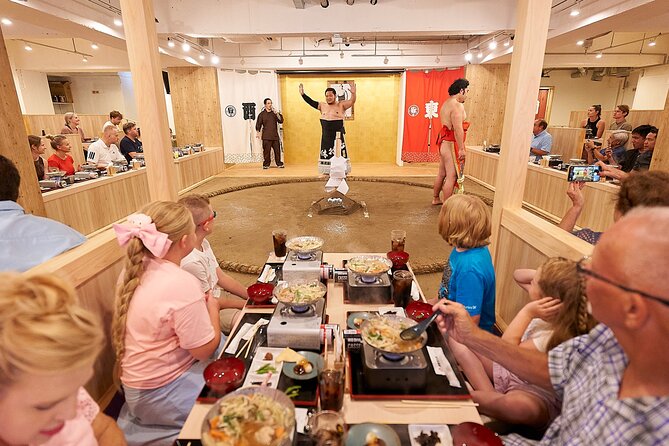
Sumo in a fun, ring-side show. In Tokyo’s Ryogoku area, this experience turns the sport into an interactive program you can enjoy from start to finish. Expect former pro wrestlers, ceremonies, audience call-outs, and hands-on traditions all in about 90 minutes.
My favorite part is the mix of chanko hot pot and real wrestler energy in the same ticket. Second, I like that mochi pounding is built for kids and adults, so you are not just watching from a distance.
One thing to consider: your seat location is assigned (no selection), and if lots of people join the challenges, participation can be limited or decided by lottery.
In This Review
- Key Highlights to Know Before You Go
- Ryogoku Sets the Tone for a Sumo Day
- Timing, Seating, and How the 1.5-2 Hour Flow Works
- Chicken Chanko Hot Pot: Why the Meal Matters Here
- Entering the Ring World: Ceremonies and the Main Show
- Mochi-Pounding: The Hands-On Challenge That Builds the Memory
- Sumo Bout Challenge: What It Feels Like to Try
- Photo Time and Audience Energy
- Who Should Book This Sumo Show?
- Value in Plain Terms: Is It Worth $106.12?
- Practical Planning Tips for Your Day in Tokyo
- Should You Book SUMOLAND Tokyo Ryogoku?
- FAQ
- What does the ticket include at SUMOLAND Tokyo Ryogoku?
- How long is the experience?
- Where is SUMOLAND Tokyo Ryogoku located?
- Is the meal included vegetarian or vegan?
- What about bottled water or alcohol?
- Can I choose my seat location?
- Will I definitely get to participate in mochi pounding or the sumo bout challenge?
- How does cancellation work?
- Is the experience suitable for all ages?
Key Highlights to Know Before You Go
- Ryogoku setting: This is the sumo heartland area, close to major Tokyo sights.
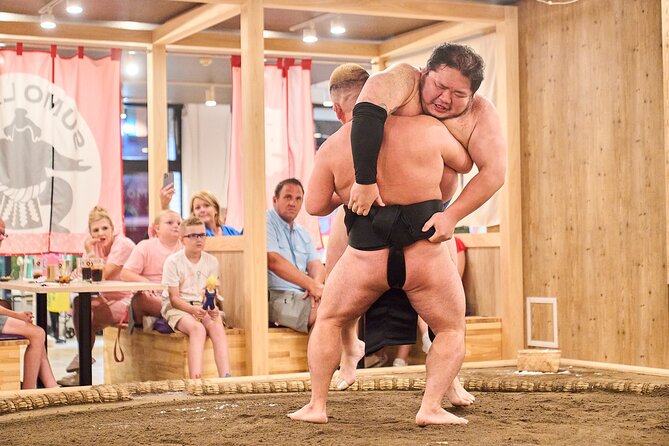
- Former top-division wrestlers on display: You get a close-up, no-filter look at the sport.
- Chicken chanko hot pot included: A proper sumo-style meal is part of the show, not an afterthought.
- Mochi pounding with the wrestlers: Hands-on fun that kids tend to love immediately.
- Audience interaction runs throughout: Photos, ring entrances, and on-the-floor challenges keep things moving.
- Diet requests are possible, with limits: Vegetarian/vegan can be arranged if you request in advance.
Ryogoku Sets the Tone for a Sumo Day
Ryogoku is where sumo belongs. It is not just a random theme for a show; it is the neighborhood tied to the culture and the people who live it. The venue sits in the Sumida area, and it is a short walk from Ryogoku Station, which matters because you do not want your day to turn into a transit scavenger hunt.
What I like about starting here is the way it helps your brain switch modes. You can go from Tokyo street life to heavy-sumo symbolism in one stop. Then the program reinforces it with action: a ring entrance ceremony, wrestler demonstrations, and audience participation that makes the sport feel less like a distant TV thing and more like something you can understand fast.
Readers booked these Tokyo options in the same breath. Here is how each one scored:
- Mt Fuji and Hakone 1-Day Bus Tour Return by Bullet Train
★ 5.0 · 26,383 reviews - 1-Day Tokyo Bus Tour
★ 5.0 · 14,250 reviews - Tokyo: teamLab Planets TOKYO Digital Art Museum Entry Ticket
★ 4.6 · 9,779 reviews - Mt Fuji & Hakone Cruise, Drum Show Bullet Train 1 Day from Tokyo
★ 4.0 · 7,413 reviews
Timing, Seating, and How the 1.5-2 Hour Flow Works
This is a compact program, roughly 1 hour 30 minutes to 2 hours, so plan it like an anchor activity. You will eat, watch, and participate in a tight timeline. The pacing is part of the value: you spend less time waiting around and more time seeing the wrestlers do what they do.
Seats are assigned by the venue, and you cannot choose where you sit. That also means you should treat your ticket as a promise of access, not a promise of view. One practical tip: if you are traveling with kids, pay attention to the guidance on lap sitting. For the standard seats, it can be dangerous to sit while holding a child on your lap, so you are asked to reserve for the exact number of people. If you want the option to hold a child on your lap, box seats are described as safer and can accommodate up to six people.
Also note the challenges. If many guests want to join the mochi-pounding or the sumo bout challenge, participation may be limited to one person per group or decided by lottery. That does not kill the experience, but it does mean you should not plan your day around a guaranteed solo turn in the ring.
Chicken Chanko Hot Pot: Why the Meal Matters Here
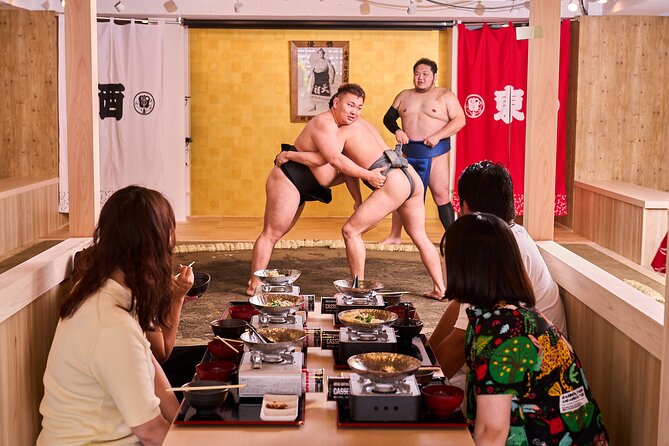
You get chicken chanko hot pot as part of your admission. In most tourist shows, the meal is basically fuel. Here, the meal feels like part of the storytelling. Chanko is the kind of food associated with sumo stable life, and having it in the same room where the wrestlers perform helps it land emotionally. You are not just hearing about tradition; you are tasting the comfort-food side of it.
The hot pot is served as a meal included with your ticket, and it is not positioned as fancy dining. It is hearty and straightforward, and multiple people highlight that the broth is a big deal. That is a good sign for your own expectations. You are going to eat something warm, savory, and filling while the program happens around you.
Diet-wise, there are some clear rules:
- Vegetarian and vegan meals are available if you request at least 2 days in advance.
- Gluten-free and halal meals are not available, so if you need those, you may want to plan on bringing your own food.
Alcoholic beverages and bottled water are not included, so if you want drinks, plan to purchase separately.
Finally, there is a mochi element tied to the program. People specifically call out the mochi dessert as a standout. Even if you are not the type to chase desserts, it is worth showing up ready for a sweet finish.
Entering the Ring World: Ceremonies and the Main Show
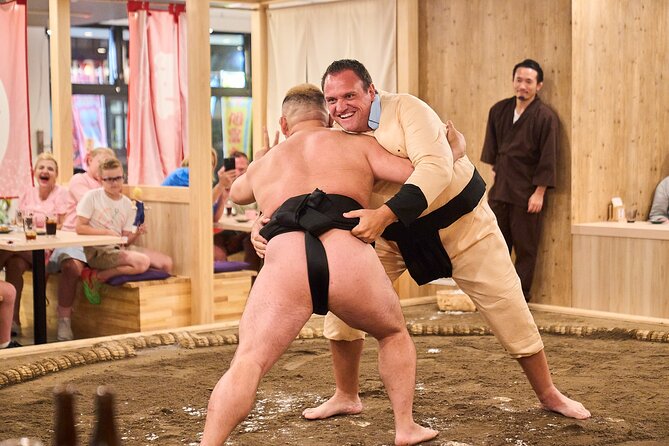
The program starts with a ring entrance ceremony. Former top-division sumo wrestlers make a powerful entrance, and that moment does a lot of work. It sets the tone before anyone tries to explain the sport in words.
Then the show begins under supervision by a Yokozuna (the 63rd Yokozuna is noted in the overview). That matters because sumo has a serious side, even when you are seeing it as entertainment. The show is not pretending sumo is only silly. It mixes performance energy with cultural signals like posture, rhythm, and respect cues.
You should expect demonstrations that explain what you are seeing in plain language. People say it is informative without getting heavy. One theme that comes through is that the wrestlers show personality, and the staff helps you understand what is happening so you are not lost.
If you are worried about language, this experience tends to be friendly for English speakers. One review notes that Japanese words are provided with translations, then you practice saying them. That kind of small teaching tool can make the whole thing feel more personal.
Mochi-Pounding: The Hands-On Challenge That Builds the Memory
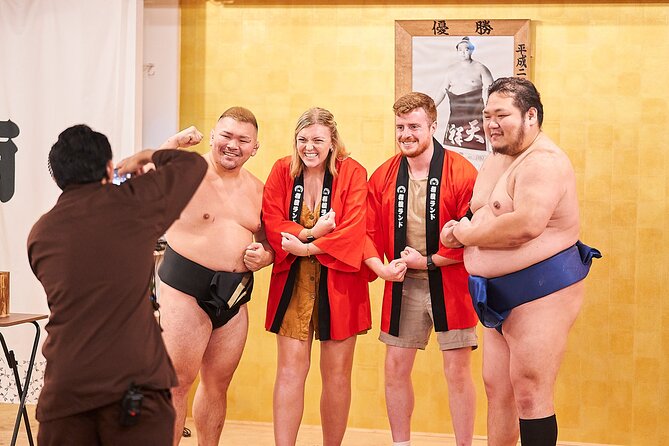
Mochi pounding is one of the biggest crowd magnets for a reason: it is physical, visual, and playful. You try traditional mochi-making with the wrestlers, and kids are welcome. That means the experience is not locked into a single age group. You can bring a family and still feel like everyone has a job to do.
Here is the reality check: if lots of guests sign up, participation might be limited to one person per group or handled by lottery. So I recommend showing enthusiasm, but keep your expectations flexible. Even if you do not get a turn, you will likely watch the process close up and understand what makes it hard.
This part also tends to create the best photos. You get a sense of teamwork and movement, and that translates well into pictures. If you are the type who likes a unique Tokyo memory, mochi pounding is exactly that.
Souvenirs are included too, and they may vary by season. That is a small detail, but it’s nice because you do not have to guess whether you will leave empty-handed.
- Tokyo: Shinjuku Food Tour (13 Dishes at 4 Local Eateries)★ 5.0 · 6,603 reviews
- Tokyo Mt Fuji 5th St & Hakone Cruise Bus Tour w/Bullet Train★ 4.4 · 5,024 reviews
- Flagship 2-Hours Official Street Go-Kart Tour – Tokyo Bay Shop★ 5.0 · 4,974 reviews
- From Tokyo: Mount Fuji Full-Day Sightseeing Trip★ 4.5 · 4,970 reviews
- Tokyo: Hop-On Hop-Off Sightseeing Bus Ticket★ 3.9 · 4,207 reviews
Sumo Bout Challenge: What It Feels Like to Try
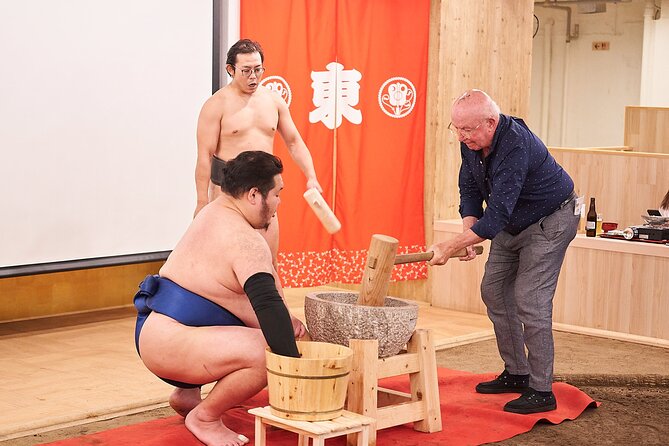
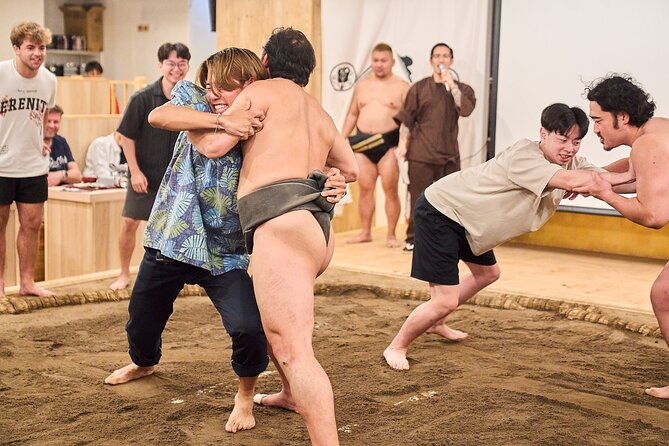
The most dramatic section of the program is the sumo bout challenge. You step into the ring and take on a real sumo wrestler. Kids are welcome here as well, and the whole point is to make sumo feel tangible.
Just remember: participation in the challenges may be limited. If it is crowded, you could be asked to wait your turn, limit turns, or accept a lottery decision. That is not a trick; it is how they keep the program running without chaos.
When you are watching, focus on the technique cues and not just the impact. Even in a short challenge, you get a snapshot of stance, balance, and the kind of force that looks simple but is not. The wrestlers help make the lesson clear. People describe it as interactive and entertaining, but the best part is that it teaches you how much work and skill sumo requires.
If you are coming with kids or teenagers, this is where the laughter often shows up. It is not only about winning. It is about the experience of trying something that is usually reserved for professionals.
Photo Time and Audience Energy
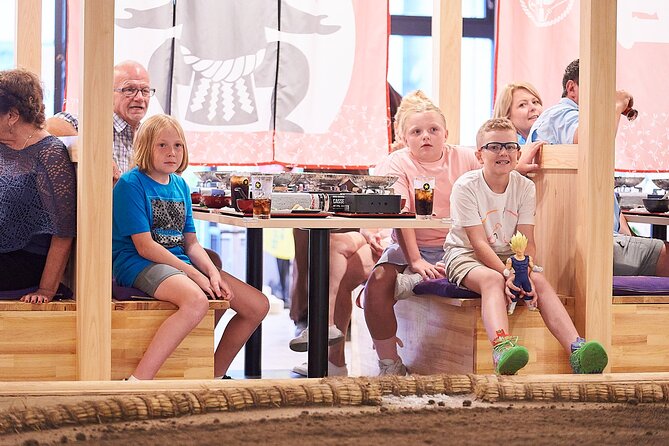
This program includes photo time with the wrestlers. In Tokyo, where photos can sometimes feel awkward, this is set up for the moment. The event organizes the energy so you are not stumbling through logistics while your camera battery dies.
Photos also help you capture the contrast that makes the day fun. You might be wearing your regular travel clothes, then suddenly you are inches from wrestlers who look like they belong in a training hall. That visual shock is part of the appeal.
The staff keeps things moving so you are not left waiting for long stretches. Many people call out that the experience is well organized and not rushed, which is important when you are mixing food with performance and participation.
Who Should Book This Sumo Show?
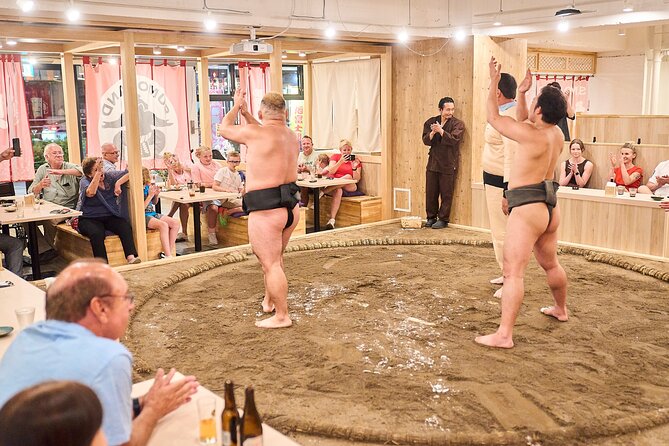
This is one of those activities that works best when you want a fun introduction to sumo culture rather than a deep technical seminar.
You will probably love it if:
- You are a first-time visitor to Tokyo and want an experience that feels local but not complicated.
- You travel with kids and need something that keeps attention without long lectures.
- You want a close-up look at former pro wrestlers, not just a museum-style display.
- You like interactive shows where you can actually do something, not just watch.
You might think twice if:
- You want something strictly traditional like official tournament viewing or morning practice. This is described as entertainment and differs from official tournaments or practice sessions.
- You dislike any element of crowd participation limits. If you come hoping for guaranteed participation in every challenge, the lottery/limit rule means you should plan for the possibility you only watch.
Value in Plain Terms: Is It Worth $106.12?
At $106.12 per person, this is not a cheap impulse activity, so you should look at value as a bundle: access + meal + hands-on moments + photos.
You get:
- Entrance fee for the full program
- Chicken chanko hot pot meal
- A souvenir
- Sumo entertainment with wrestlers, including interactive challenges and photo time
For many people, the meal is part of the value, but the show is the reason to go. This experience sells you on participation and close-up access, and the reviews strongly reinforce that the wrestlers and interaction are the main event.
If you were going to pay for a show plus a separate meal in Tokyo, this starts to look more reasonable. It also helps that the whole thing is time-efficient. Ninety minutes is short enough that you can still fit other Tokyo plans without losing half a day.
Practical Planning Tips for Your Day in Tokyo
This venue is near public transportation, and it is close to Ryogoku Station. That makes it easy to pair with other sights in the broader area. Around Ryogoku Station, you can connect to popular Tokyo sightseeing like Asakusa, Akihabara, Nihonbashi, and Tokyo Skytree.
My suggestion: schedule this as your earlier anchor. Then you can use the afternoon/evening for wandering neighborhoods at your own pace. Since the program is compact and starts on time, you will lose less of your day to delays than you might with longer tours.
Also, since alcohol and bottled water are not included, consider whether you want to buy drinks on site or bring what you can. The safest move is to plan for water as an extra cost so you are not surprised.
Finally, if you have food needs, handle them early. Vegetarian and vegan meals require a request at least 2 days in advance, and gluten-free/halal are not available. You do not want to be making food decisions the day before.
Should You Book SUMOLAND Tokyo Ryogoku?
Book it if you want a high-energy, family-friendly sumo introduction with hands-on moments. The combo of chanko hot pot, wrestler-led challenges like mochi pounding, and the chance to try sumo is exactly what makes this sort of event memorable.
Skip or adjust expectations if you are chasing a strict, traditional-only experience or if you cannot handle participation limits. Your seats are assigned, and challenge participation can be constrained by lottery or group limits.
If you fit the target—curious about sumo, want interaction, and want a well-run Tokyo activity—this is a strong choice for a unique day in Ryogoku.
FAQ
What does the ticket include at SUMOLAND Tokyo Ryogoku?
Your admission includes the entrance fee, chicken chanko hot pot, and a souvenir.
How long is the experience?
It runs about 1 hour 30 minutes to 2 hours.
Where is SUMOLAND Tokyo Ryogoku located?
The address is 1F Takashima Ryogoku Mansion, 4-32-19 Ryogoku, Sumida City, Tokyo 130-0026, Japan.
Is the meal included vegetarian or vegan?
Vegetarian and vegan meals are available if you request them at least 2 days in advance. Gluten-free and halal meals are not available.
What about bottled water or alcohol?
Alcoholic beverages and bottled water are not included.
Can I choose my seat location?
No. Seat locations are assigned by the venue, and you cannot select them.
Will I definitely get to participate in mochi pounding or the sumo bout challenge?
Participation can be limited if many guests join, and it may be decided by lottery or limited to one person per group.
How does cancellation work?
Free cancellation is available up to 24 hours in advance for a full refund. Within 24 hours, the amount paid is not refunded.
Is the experience suitable for all ages?
Most travelers can participate, and the program notes that it is an entertainment program for both adults and children, with kids welcome for the challenges.
More Tour Reviews in Tokyo
- Mt Fuji and Hakone 1-Day Bus Tour Return by Bullet Train
★ 5.0 · 26,383 reviews - 1-Day Tokyo Bus Tour
★ 5.0 · 14,250 reviews - Tokyo: teamLab Planets TOKYO Digital Art Museum Entry Ticket
★ 4.6 · 9,779 reviews - Mt Fuji & Hakone Cruise, Drum Show Bullet Train 1 Day from Tokyo
★ 4.0 · 7,413 reviews - Tokyo: Shinjuku Food Tour (13 Dishes at 4 Local Eateries)
★ 5.0 · 6,603 reviews





