
Reviewed · FULL-DAY
Full-Day Accessible Tour of Tokyo for Wheelchair Users
Tokyo gets easier when stairs aren’t in charge. This private, barrier-free route links major sights in Asakusa, Shibuya, and Meiji Jingu, with train travel built in so you’re not stuck figuring out Tokyo’s rail maze.
I love the hotel pickup and drop-off within Tokyo’s 23 wards, which makes the day feel organized instead of improvisational. I also like that you can go at your own pace, with a guide who’s comfortable adjusting when mobility needs kick in.
One possible drawback: at $191.08 per person, you’re paying for support, not just transportation. If you’re the type who prefers to wander solo with no structure, this may feel pricier than DIY Tokyo day plans.
In This Review
- Key things you’ll notice right away
- Why this wheelchair-smart Tokyo route feels less stressful
- Price and value: what $191.08 really buys you
- Your 7-hour flow: Asakusa first, then Shibuya, then shrine calm
- Stop 1: Asakusa Culture Tourist Information Center (a Kengo Kuma start)
- Stops 2 and 3: Nakamise Shopping Street and Senso-ji
- Stop 4: Sumida Park and Tokyo Skytree views
- Stops 5 and 6: Shibuya Crossing and Cat Street (two Tokyo moods)
- Stop 7: Meiji Jingu Shrine for a slower reset
- Stop 8: Omotesando, the tree-lined boulevard finish
- Train travel with a guide: where the real accessibility magic happens
- What makes each stop “wheelchair-friendly” in practice
- Which guides you might want to ask about (and why it matters)
- Who should book this tour (and who might pass)
- Should you book this accessible Tokyo tour?
- FAQ
- How long is the full-day accessible Tokyo tour?
- What time does the tour start, and is there a set schedule?
- Is this a private tour, and what is the minimum group size?
- Does the price include hotel pickup/drop-off and train tickets?
- What is not included in the tour price?
- Is it designed for wheelchair users, and are service animals allowed?
- Where does the tour start and end?
Key things you’ll notice right away
- Wheelchair-focused routing that keeps the day practical, not just scenic
- Train tickets included, so your guide can handle the metro hops for you
- Hotel pickup and drop-off within Tokyo’s 23 wards, which saves real energy
- A private group format, usually with a guide giving attention to your pace
- Sights chosen for short, high-impact stops, from Asakusa to Harajuku area
Why this wheelchair-smart Tokyo route feels less stressful
Tokyo can be a test when you’re navigating ramps, station corridors, and crowd flow. This tour is built around wheelchair users, with a route that aims to reduce the usual friction—waiting, detours, and the constant question of where the next accessible path is.
You’re not just “seeing Tokyo.” You’re traveling like a local by train with an expert guide at your side. That matters because Tokyo’s public transit system rewards people who know which exits and transfers make sense.
The big win is that the tour is designed as a private experience, not a group cattle-car situation. Your guide can slow down, pause, and reroute when the day needs it—one of the themes I noticed in how the guides were praised by people needing extra mobility care.
Readers also shortlisted these Tokyo bookings:
- From Tokyo: Mount Fuji Full-Day Sightseeing Trip
★ 4.5 · 4,970 reviews - Mount Fuji Full-Day Private Tour from Tokyo (Customizable)
★ 4.9 · 1,470 reviews - From Tokyo: Mount Fuji Full Day Customizable Private Tour
★ 4.9 · 912 reviews - Tokyo Private Full-Day Tour by Car or Van
★ 5.0 · 684 reviews
Price and value: what $191.08 really buys you
$191.08 per person sounds like a splurge until you line up what’s included. You get a professional guide, train tickets, and hotel pickup and drop-off across Tokyo’s 23 wards. Add the private format, plus mobile ticket support, and you’re basically paying for a day where you don’t have to coordinate transit, timing, or accessibility logistics.
This is the kind of value that shows up when you’re tired. If your knees or your chair tires out faster than your sightseeing hunger, the “saved effort” becomes real savings.
Also, the tour runs about 7 hours, which is enough time to cover multiple neighborhoods without racing. You’re paying to avoid the “one more stop” scramble that can turn a fun day sour.
Your 7-hour flow: Asakusa first, then Shibuya, then shrine calm
The schedule starts at 9:30am with a focus on Asakusa, then gradually shifts into Tokyo’s modern buzz. You’ll spend shorter blocks at the busier photo spots, then settle into longer time at places like Meiji Jingu where you can breathe.
The stops are paced in a way that works for mobility needs. The tour leans on places with defined sights and clear arrival points, like Kaminarimon and Senso-ji in Asakusa, then Shibuya Crossing and Cat Street for the pop-culture contrast.
You end back at the meeting point, so your day doesn’t drift into a “how do we get home?” puzzle. Hotel pickup and drop-off also helps you conserve energy for what you actually came to do.
Stop 1: Asakusa Culture Tourist Information Center (a Kengo Kuma start)
You begin at the Asakusa Culture Tourist Information Center, an 8-story building designed by Kengo Kuma. It’s more than a useful starting point; it’s a modern landmark in the heart of Asakusa, and it gives you an easy place to regroup before you move into the historic lanes.
This stop is short—about 15 minutes—and admission is free. In practice, it’s a smart warm-up: you get orientation, your guide can confirm the plan, and you’re not rushing straight into crowds.
If you like architecture, this is a nice early payoff because it contrasts modern design with the older atmosphere you’ll hit in the next stops.
Stops 2 and 3: Nakamise Shopping Street and Senso-ji
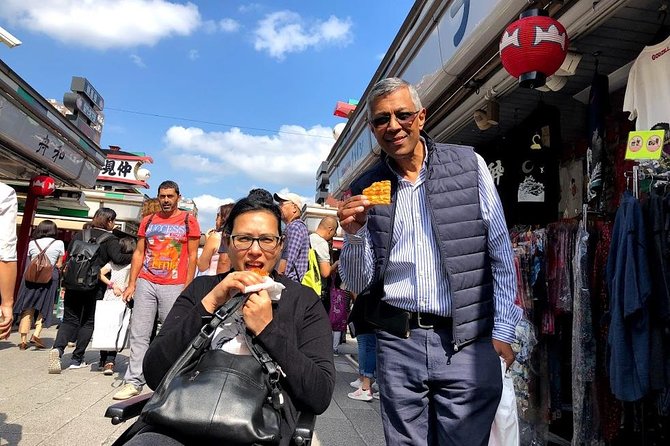
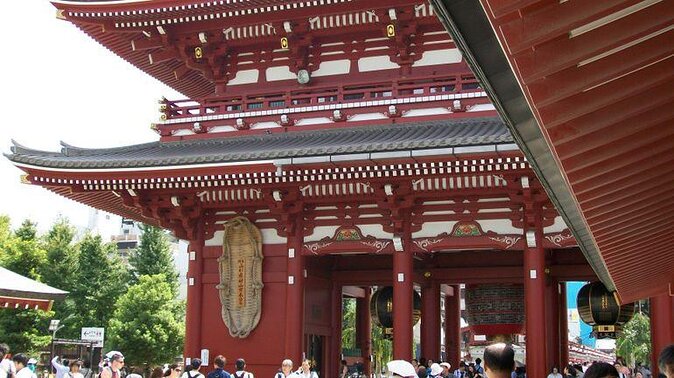
Next is Nakamise Shopping Street leading in through Kaminarimon (Thunder Gate), the outer gate tied to Senso-ji. This is your classic Asakusa entrance moment: a dense shopping street right up against the temple approach.
You’ll have around 20 minutes here, and it’s free. The challenge isn’t the walking so much as the crowd pressure. In a wheelchair, that means your guide’s ability to position you and keep you moving matters more than you’d think.
Then comes Senso-ji Temple, one of Tokyo’s best-known temples. You get about 20 minutes, and admission is free. It’s the type of place where you don’t need long hours to feel the atmosphere, especially when your goal is to keep momentum through multiple neighborhoods.
A practical tip: treat these temple-area minutes as “see the main views, then enjoy the details.” When the day is structured, you can linger without losing the whole schedule.
- Tokyo: Shinjuku Food Tour (13 Dishes at 4 Local Eateries)★ 5.0 · 6,603 reviews
- Tokyo Mt Fuji 5th St & Hakone Cruise Bus Tour w/Bullet Train★ 4.4 · 5,024 reviews
- Flagship 2-Hours Official Street Go-Kart Tour – Tokyo Bay Shop★ 5.0 · 4,974 reviews
- From Tokyo: Mount Fuji Full-Day Sightseeing Trip★ 4.5 · 4,970 reviews
- Tokyo: Hop-On Hop-Off Sightseeing Bus Ticket★ 3.9 · 4,207 reviews
Stop 4: Sumida Park and Tokyo Skytree views
After the Asakusa center and temple energy, the tour slides into a calmer river-side moment at Sumida Park. It’s near Asakusa Station and stretches along the Sumida River, with views that include Tokyo Skytree.
This stop is about 15 minutes, free to enjoy. If you happen to be in season, the park is known for cherry blossoms, which is one of those “Tokyo does romance well” details that’s worth timing if your trip lines up.
The real value here is the break. Even for people who love sightseeing, your senses appreciate a short reset between historic Asakusa and the high-intensity zones that come next.
Stops 5 and 6: Shibuya Crossing and Cat Street (two Tokyo moods)
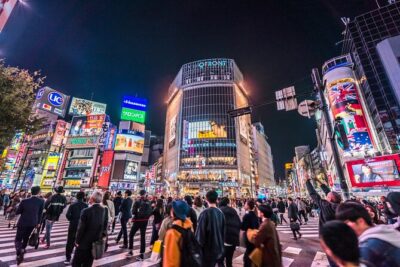
Shibuya is where Tokyo turns volume up. You’ll stop at Shibuya Crossing near Shibuya Station, with a guide-led window of about 20 minutes.
The numbers are wild: around 500,000 people per day, and at peak times up to 3,000 people cross at one green light. Even if you’ve seen photos, it’s one of those places where the scale hits you in real time. For wheelchair users, having the guide manage where you stand and when you cross is a big deal.
After that, you head to Shibuya Cat Street, about 25 minutes. This is the stylish, street-level contrast between Harajuku and Shibuya, and it’s described as a half-mile long stretch lined with stores aimed at people in their 20s and 30s.
If you want a more “Tokyo-in-motion” flavor rather than another landmark, this stop delivers. If crowds overwhelm you, use this as your “watch from the edges” moment and still enjoy the vibe.
Stop 7: Meiji Jingu Shrine for a slower reset
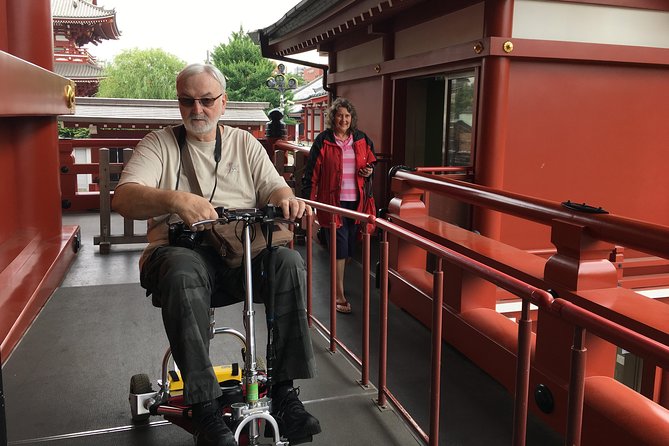
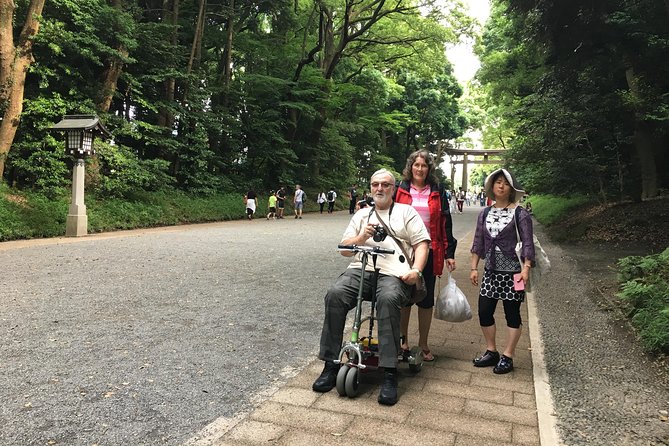
Then you shift gears to Meiji Jingu Shrine, which is dedicated to the deified spirits of Emperor Meiji and his consort, Empress Shoken. The time here is longer—around 50 minutes—and admission is free.
This is a great change of pace after Shibuya’s intensity. The shrine’s location near the JR Yamanote line and Harajuku area makes the contrast extra clear: modern station life outside, calm sanctuary inside.
In wheelchair terms, longer time at one site can be easier to manage than endless stop-and-go. You’re not constantly climbing between neighborhoods. You can take your time, ask questions, and settle into the atmosphere without feeling you’re always “behind schedule.”
Stop 8: Omotesando, the tree-lined boulevard finish
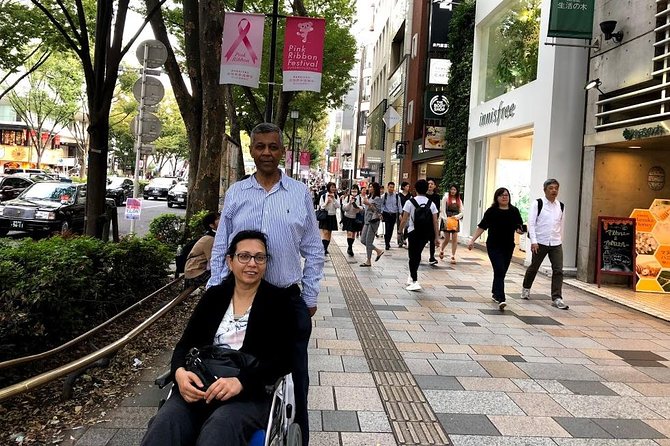
Your final stop is Omotesando, a sloping, tree-lined boulevard in the Aoyama district. It runs through parts of both Shibuya and Minato wards, so it works as a neat wrap-up between the trend zones and the more upscale, design-forward side of the city.
You’ll have about 20 minutes, free to explore. If you like architecture, storefront rhythm, and streets that feel designed rather than random, Omotesando is a satisfying last look.
As the day winds down, it’s also a practical stop: it’s visually rewarding without requiring a marathon.
Train travel with a guide: where the real accessibility magic happens
The tour includes train tickets, which sounds simple until you’re actually standing in a busy station with time pressure. Here, your guide handles navigation and helps you use the metro system more comfortably.
In the way the guides were described—people like Fumiko, Kaori, Emiko-san, Yumi, Machiko, and Michiko—the emphasis is always on keeping things manageable: planning the day, helping you meet up smoothly, and tracking your group even in dense areas.
One detail that really stands out for people using wheelchairs and rollators: station support. Japanese stations often have staff who provide ramps when needed, and having your guide in the loop can make that assistance easier to access at the right moment.
You can still prepare for the usual realities of public transit: allow extra patience at peak crowd times and keep your transfers simple. But you’re not doing it alone.
What makes each stop “wheelchair-friendly” in practice
The key is that the stops are chosen to minimize guesswork. Temple approaches like Kaminarimon and routes near Asakusa Station reduce uncertainty because you’re not hunting for “where’s the accessible entrance?”
Busy photo sites like Shibuya Crossing are included, but the tour allocates a controlled time block. That means you’re not stuck waiting too long just to get a photo, which is a common fatigue trap in crowded cities.
Meanwhile, Meiji Jingu gets a longer window, so you can enjoy it without turning it into a sprint. That mix—short intensity, then longer calm—helps the day feel doable.
Which guides you might want to ask about (and why it matters)
Because this is a private tour, guide style can strongly affect your comfort level. People have been specifically impressed with guides like Keita Mizuri, Michiko, Machiko, Fumiko, Kaori, Emiko-san, and Yumi.
The recurring theme is thoughtful pacing and solid handling of crowded areas and mobility needs. In other words: you’re not just getting a person who reads facts off a sign. You’re getting someone who helps you keep moving, keeps track of everyone, and adjusts when your body calls the shots.
If you have specific needs—transfer timing, slower approach to crowds, or a preference for fewer busier stops—ask your guide early. This is one of those tours where good communication is part of the value.
Who should book this tour (and who might pass)
This tour fits best if you want a guided day that still respects your mobility limits. You’ll likely love it if you don’t want to spend time learning Tokyo’s transit quirks, or if “accessible” on paper needs real help in busy places.
It also makes sense if you’re traveling with a caregiver. The tour notes that the minimum group size includes caregivers, which can be a relief for planning.
If you’re fully independent, enjoy planning your own routes, and don’t need help navigating station transfers, you may decide to DIY. But if you want Tokyo highlights delivered with less friction, this tour is built for that exact goal.
Also, keep in mind the tour expects moderate physical fitness. Even with wheelchair support, you’ll still be part of a day built around movement and transit time.
Should you book this accessible Tokyo tour?
If your priority is a stress-reduced day with major sights and real help with train navigation, I think this is a strong choice. The included hotel pickup and drop-off, train tickets, and private guide mean you can spend your energy on actually enjoying Tokyo, not decoding routes.
I’d book it especially if you’re aiming to see multiple neighborhoods without letting logistics steal the day. And if you’re on the fence about cost, remember you’re paying for coordination and pace—often the difference between a “great photo day” and a “good day in Tokyo.”
One final practical note: the tour supports free cancellation up to 24 hours in advance, so you can book without feeling totally locked in.
FAQ
How long is the full-day accessible Tokyo tour?
The tour lasts about 7 hours.
What time does the tour start, and is there a set schedule?
The start time is 9:30am. The day follows a set sequence of major stops, with time at each location.
Is this a private tour, and what is the minimum group size?
Yes, it’s a private tour, and there is a minimum of 2 people per booking, which includes caregivers.
Does the price include hotel pickup/drop-off and train tickets?
Yes. The price includes hotel pickup and drop-off within the 23 wards of Tokyo, plus train tickets and a professional guide.
What is not included in the tour price?
Food and drinks are not included. Also, private transportation like taxi or a private car/bus is available only for an extra fee.
Is it designed for wheelchair users, and are service animals allowed?
The tour is designed for wheelchair users and aims for a barrier-free experience. Service animals are allowed, and the tour notes you should have moderate physical fitness.
Where does the tour start and end?
It starts at Asakusa Culture Tourist Information Center in Taito City (Kaminarimon area) and ends back at the meeting point.
More Full-Day in Tokyo
- From Tokyo: Mount Fuji Full-Day Sightseeing Trip
★ 4.5 · 4,970 reviews - Mount Fuji Full-Day Private Tour from Tokyo (Customizable)
★ 4.9 · 1,470 reviews - From Tokyo: Mount Fuji Full Day Customizable Private Tour
★ 4.9 · 912 reviews - Tokyo Private Full-Day Tour by Car or Van
★ 5.0 · 684 reviews - From Tokyo: Must-Visit Mount Fuji Highlight Full-Day Tour
★ 4.7 · 532 reviews
More Tours in Tokyo
- Mt Fuji and Hakone 1-Day Bus Tour Return by Bullet Train
★ 5.0 · 26,383 reviews - 1-Day Tokyo Bus Tour
★ 5.0 · 14,250 reviews - Tokyo: Shinjuku Food Tour (13 Dishes at 4 Local Eateries)
★ 5.0 · 6,603 reviews - Tokyo Mt Fuji 5th St & Hakone Cruise Bus Tour w/Bullet Train
★ 4.4 · 5,024 reviews - Flagship 2-Hours Official Street Go-Kart Tour – Tokyo Bay Shop
★ 5.0 · 4,974 reviews
More Tour Reviews in Tokyo
- Mt Fuji and Hakone 1-Day Bus Tour Return by Bullet Train
★ 5.0 · 26,383 reviews - 1-Day Tokyo Bus Tour
★ 5.0 · 14,250 reviews - Tokyo: teamLab Planets TOKYO Digital Art Museum Entry Ticket
★ 4.6 · 9,779 reviews - Mt Fuji & Hakone Cruise, Drum Show Bullet Train 1 Day from Tokyo
★ 4.0 · 7,413 reviews - Tokyo: Shinjuku Food Tour (13 Dishes at 4 Local Eateries)
★ 5.0 · 6,603 reviews
Latest Tokyo reviews off our desk

Full-Day, compared.
 ★ 4.5From Tokyo: Mount Fuji Full-Day Sightseeing TripFrom $684,970 reviews
 ★ 4.9Mount Fuji Full-Day Private Tour from Tokyo (Customizable)From $3931,470 reviews
 ★ 4.9From Tokyo: Mount Fuji Full Day Customizable Private TourFrom $407912 reviews
 ★ 5.0Tokyo Private Full-Day Tour by Car or VanFrom $321684 reviews
 ★ 4.7From Tokyo: Must-Visit Mount Fuji Highlight Full-Day TourFrom $69532 reviews
 ★ 4.5Mount Fuji and Hakone Full Day Tour with Ramen MakingFrom $94476 reviews
 ★ 4.5Mt. Fuji, Hakone Full-Day Private Tour with English Driver GuideFrom $495458 reviews
★ 4.8From Tokyo: Mount Fuji Full-Day Customizable Private TourFrom $483451 reviews
★ 4.5Mt. Fuji, Hakone Full-Day Private Tour with English Driver GuideFrom $495458 reviews
★ 4.8From Tokyo: Mount Fuji Full-Day Customizable Private TourFrom $483451 reviews