
Reviewed · MOUNT FUJI TOURS
Fuji Photo Tour
Mt. Fuji starts here, even when clouds hover. This private Fuji Photo Tour in Fujikawaguchiko-Machi gives you structured stops for classic views and includes photo and video data so you leave with more than just memories. One thing to plan around: the tour only runs in good weather, so you’ll need flexibility if the mountain hides.
What I like is how the day is paced for photography, not sightseeing fatigue. You get a calm flow across multiple Fuji viewpoints, with enough time at each stop to try different angles and compositions.
A second strong point for me is the human part. The guide team (often mentioned as Ryo and Ericko) keeps communication simple, and they use translation tools when English isn’t fluent.
In This Review
- Key Highlights You’ll Actually Notice
- Getting to Forest Mall Fujikawaguchiko and Starting Smoothly
- Price and Value: What $423.49 Per Group Really Buys
- The Weather Rule That Changes Everything (So Plan for Clouds)
- Stop-by-Stop: One Fuji Photo Loop From Kawaguchiko to Shoji
- Lake Kawaguchiko: Your First Big Fuji Shot Window (2 Hours)
- Chureito Pagoda: Stairs, a Gentle Slope, and a Classic Fuji Backdrop (30 Minutes)
- Oshino Hakkai: Crystal-Clear Spring Water With Fuji Behind It (30 Minutes)
- Haha no Shirataki Falls: A Quieter Waterfall Reset (30 Minutes)
- Oishi Park: Flower Color and Lavender Season for Purple Fuji Stories (20 Minutes)
- Aokigahara Forest: Lava Formations and Fuji Jukai Moods (20 Minutes)
- Saiko (Lake Sai): A Calmer Lake Session Away From Main Crowds (30 Minutes)
- Lake Shoji: Peaceful, Less Crowded Fuji Foot-Footage (20 Minutes)
- Communication and Guide Style: What You’ll Get From Ryo and Ericko
- Who Should Book This Fuji Photo Tour—and Who Might Skip It
- Should You Book? My Take
- FAQ
- How long is the Fuji Photo Tour?
- What does the price cover, and how many people are in a group?
- Is pickup available?
- Where does the tour start?
- Is lunch included?
- Are admission tickets included?
- What happens if the weather is bad?
- Is this tour stroller-friendly?
Key Highlights You’ll Actually Notice
- Private group up to 8: your shooting pace and angles won’t feel rushed
- Photo and video data included: you’re not just chasing your own phone battery
- 8 icon stops with free tickets at several spots: you can focus on framing, not gate fees
- Stairs and slopes are part of the plan: especially near the Chureito Pagoda viewpoint
- Oishi Park seasonal color, including lavender season: great for adding color to your Fuji story
- Multiple Fuji-lake options: Kawaguchiko to Saiko and Shoji gives you variety without long commutes
Getting to Forest Mall Fujikawaguchiko and Starting Smoothly
Your tour begins at Forest Mall Fujikawaguchiko (8017-1 Kodachi, Fujikawaguchiko, Minamitsuru District, Yamanashi 401-0302). The experience runs roughly Monday through Friday, with operating hours listed as 8:30 AM to 5:00 PM. This matters because it shapes lighting too: late morning into afternoon is prime for exploring viewpoints, while early starts can help if you’re trying to beat crowds at specific angles.
If pickup is offered for your group, it saves real energy. The tour uses an air-conditioned vehicle and includes private transportation, which is a big deal in this part of Japan where getting between lakeside spots can eat up time fast. There’s also a mobile ticket, which makes check-in simpler once you’re on site.
The tour ends back at the meeting point, so you’re not dealing with an awkward “drop-off somewhere else” problem. And yes, the experience is a photo-and-video tour—so expect stops designed around shooting, not just looking.
More Fuji day trips our readers rated highly
- Mt Fuji Area Private Guided Tours in English-Nature up close, quiet, personal
★ 5.0 · 288 reviews - Explore Mt. Fuji Ice Cave in Aokigahara Forest
★ 5.0 · 243 reviews - Ramen Cooking Class at Ramen Factory in Mt.Fuji
★ 5.0 · 101 reviews - Early Morning Kayaking With Views of Mt Fuji at Lake Kawaguchiko
★ 5.0 · 69 reviews
Price and Value: What $423.49 Per Group Really Buys
The price is $423.49 per group (up to 8). For a lot of people, the key value isn’t the headline cost—it’s what’s included.
Here’s what you’re paying for beyond transportation:
- Air-conditioned vehicle + private transport
- Photo and video data
- Tickets for several attractions (multiple stops list admission tickets as free)
- A guide who helps with the “how” of shooting, not only the “where”
If you book with a full group of 8, you’re effectively spreading the cost across several people. If you’re traveling solo, you may pay more per person than a larger group would, but the trade is clarity: private shooting time and a planned route built for Fuji shots.
One cost that isn’t covered: lunch. Plan to eat on your own before or after, or bring snacks if you know you get hungry during long sightseeing days. Also note: infant high chairs aren’t provided, so if that affects you, plan accordingly.
The Weather Rule That Changes Everything (So Plan for Clouds)
This experience operates only in good weather. If it’s canceled due to poor weather, you’ll either be offered a different date or a full refund. That policy is there because Mount Fuji photography is brutally weather-dependent—clouds and haze can turn the mountain into a faint suggestion.
Here’s the practical way to think about it: you’re not just visiting scenic spots. You’re building a photo plan around visibility. On many days, the goal is not perfect conditions everywhere—it’s finding the moments when Fuji shows itself clearly, then shooting fast with the right framing.
Your best move is to keep your schedule flexible. If you’re thinking of booking while you’ll also be locked into other tight plans that week, consider moving this tour to a day with more cushion.
Stop-by-Stop: One Fuji Photo Loop From Kawaguchiko to Shoji
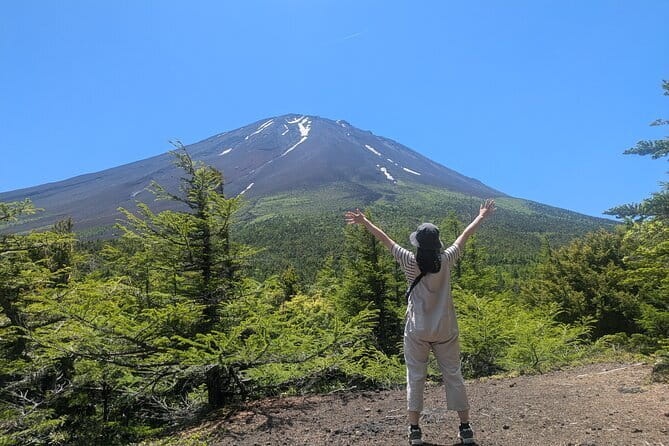
This is a tight 5-hour circuit focused on different angles of the same mountain. That’s smart, because Fuji isn’t just one “view.” You’re chasing changes in perspective—lakes, pagoda lines, waterfall textures, forest geometry, and seasonal flower color.
You’ll have eight shooting stops, ranging from about 20 minutes to about two hours. Short stops are normal here. They’re built for quick composition checks: adjust your height, try foreground elements, then move on before the light shifts too far.
Also, communication can be simple-English based. The guide team isn’t described as fluent in English, but they use simple phrases and translation tools—so you’re not expected to speak perfect Japanese to enjoy the day.
Now, let’s look at each stop.
Lake Kawaguchiko: Your First Big Fuji Shot Window (2 Hours)
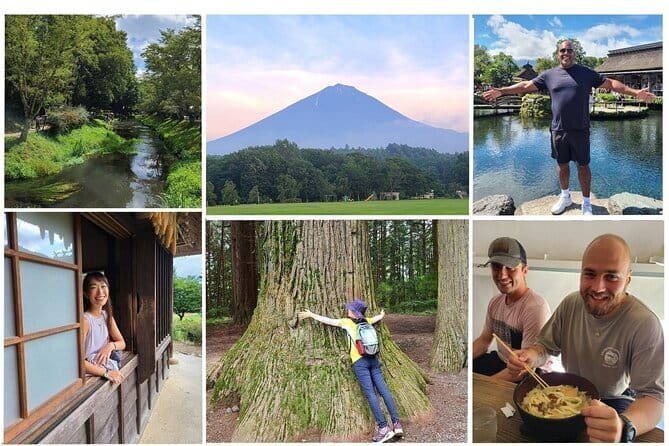
You start at Lake Kawaguchiko, with about two hours on the water-facing area. The admission ticket is free for this stop. This longer block is where you’ll get your bearings and try multiple viewpoints without feeling rushed.
Why it’s a good first stop: Kawaguchiko acts like your base layer for the whole tour. Even if Fuji is partly hidden, you’ll still be able to practice the kind of framing you’ll reuse later: mountain-in-frame setups, foreground layering, and horizon alignment.
Practical tip: use this time to test your camera settings early. If you’re shooting in a mix of cloud and sun, dialing in exposure now saves you from panic later.
Readers also shortlisted these Fujikawaguchiko machi bookings:
- Mt. Fuji 2-Hour Photo Shoot with a Local Photographer-Kawaguchiko★ 5.0 · 6 reviews
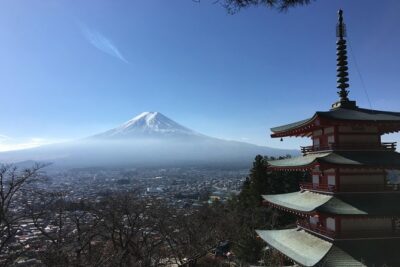
Chureito Pagoda: Stairs, a Gentle Slope, and a Classic Fuji Backdrop (30 Minutes)
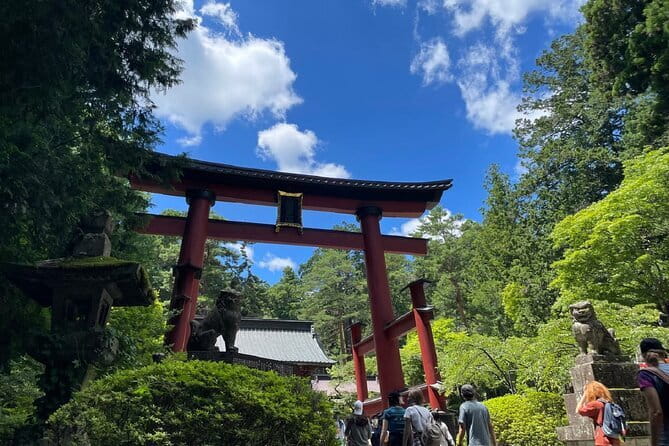
Next up is Chureito Pagoda, with about 30 minutes. The viewpoint requires climbing stairs and walking along a gentle slope. Admission is free.
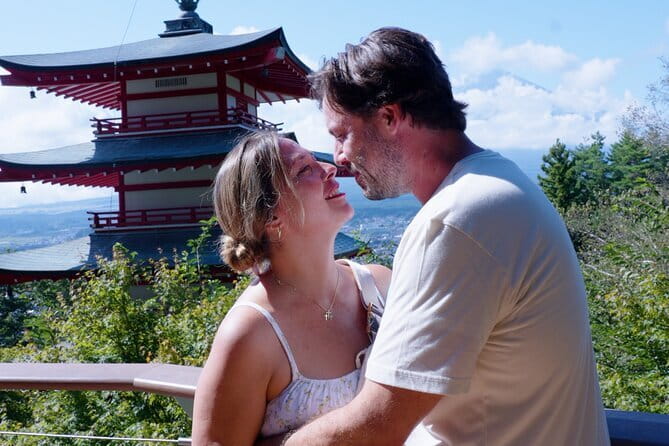
This stop is all about the “icon” composition. You’re shooting a strong vertical subject against Fuji’s shape, which means your position matters a lot. If you’re planning to travel with limited mobility, keep the stairs in mind. You might still enjoy the stop, but you’ll want to pace yourself, and you may prefer shooting from areas with fewer steps.
If you’re bringing a tripod, keep it short and stable. The area is compact, and you’ll want to avoid blocking other photographers.
Oshino Hakkai: Crystal-Clear Spring Water With Fuji Behind It (30 Minutes)
At Oshino Hakkai, you get about 30 minutes. The key appeal here is simple: tranquil ponds, clear water, and seasonal scenery with Mount Fuji in the background. Admission is free for this stop.
This is a nice shift from the more iconic landmarks. Instead of one big “pose,” you’ll likely find lots of small scenes: water reflections, Fuji-shaped negative space, and background layering.
Drawback to consider: thirty minutes sounds brief, but Oshino Hakkai can also be visually dense. To make the most of your time, decide what you want first—reflection shot, water texture, or Fuji framed by surrounding elements—then work that plan.
Haha no Shirataki Falls: A Quieter Waterfall Reset (30 Minutes)
You’ll stop at Haha no Shirataki (Mother’s White Waterfall) in Fujikawaguchiko town for about 30 minutes, with free admission.
The attraction here is serenity. This is described as a tranquil spot where you can photograph the waterfall cascading down naturally. It’s also a useful break in the day: after pagoda stairs and lake views, waterfall motion gives your photos a different texture.
Timing note: with a short stop, focus on getting one or two strong angles rather than trying to see everything. Waterfall areas can also shift in brightness as clouds pass, so be ready to shoot quickly when conditions improve.
Oishi Park: Flower Color and Lavender Season for Purple Fuji Stories (20 Minutes)
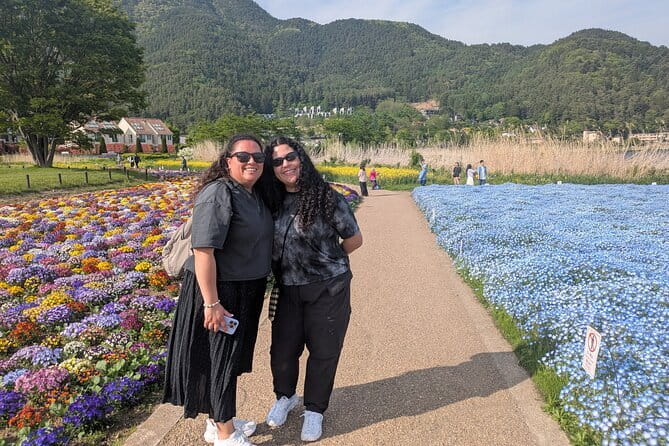
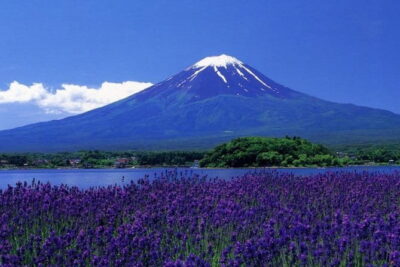
Oishi Park is next, with about 20 minutes and free admission. This stop is known for breathtaking Mount Fuji views and seasonal flowers. During lavender season, you’ll see a purple carpet spread out in the scene.
This is where you add storytelling color. If your camera roll so far is mostly “Fuji + sky,” Oishi Park can give you a stronger foreground element and a more colorful frame.
Consideration: twenty minutes is short, so don’t wait for the perfect moment to start shooting. Look for your best angle, frame quickly, and capture from the main flower direction and one alternate side if time allows.
Aokigahara Forest: Lava Formations and Fuji Jukai Moods (20 Minutes)
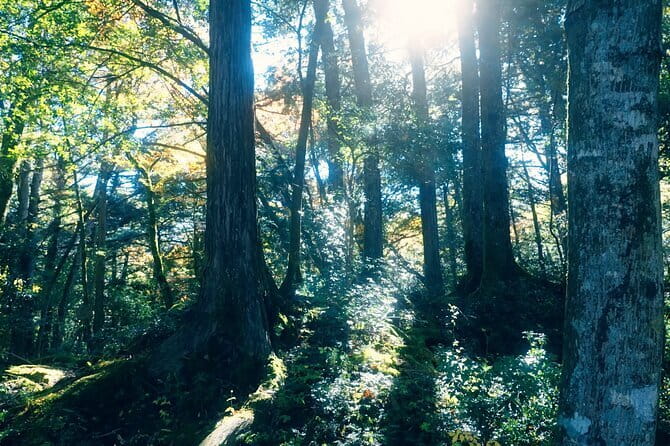
At Aokigahara Forest (listed as Fuji Jukai), you’ll have about 20 minutes. The focus is the mysterious forest feeling and lava formations at the foot of Mount Fuji, surrounded by nature.
This is a strong choice if you want more than postcards. Forest photography changes your contrast and your texture: darker paths, rock shapes, and a slower pace visually. Even if Fuji is partially obscured here, the environment still delivers meaning—your photo can feel like Fuji’s footstep, not just Fuji’s portrait.
Practical note: forest stops can be tricky for camera stability because ground surfaces may vary. Keep your gear secure and move carefully.
Saiko (Lake Sai): A Calmer Lake Session Away From Main Crowds (30 Minutes)
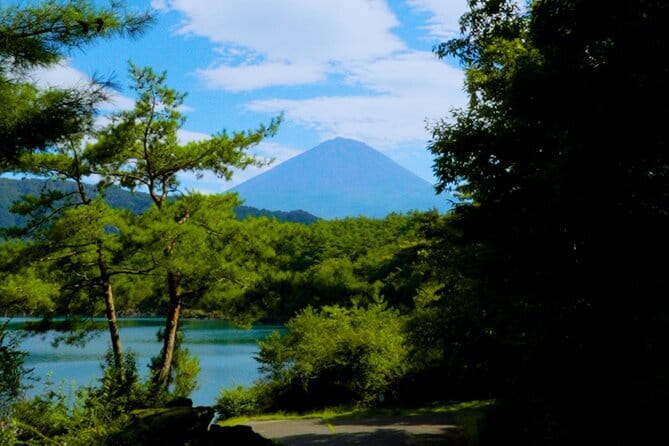
Next is Saiko (Lake Sai), around 30 minutes with free admission. It’s a Fuji Five Lakes location known for tranquility and natural beauty. The stop is described as away from crowds, which matters if you want cleaner compositions.
This is a good place to slow down. With a lake setting, you can try wider shots and then zoom in with tighter framing. When Fuji is visible, this stop can also help you capture Fuji at a different scale than Kawaguchiko.
If you’re shooting reflections, remember that water can change quickly. Watch for small ripples and adjust your timing instead of forcing one exact setting for too long.
Lake Shoji: Peaceful, Less Crowded Fuji Foot-Footage (20 Minutes)
Your final stop is Lake Shoji (Shojiko), about 20 minutes with free admission. It’s described as peaceful and slightly removed from the bustle of more crowded tourist spots, making it another calmer option for photography.
This stop rounds out the day by adding variety. Where Kawaguchiko feels like your opening act and Saiko offers a calmer lake session, Shoji can feel like your quieter encore—another angle, another mood.
Short stop reality: use it for 3 things—one wide, one mid, one detail (if conditions allow). Then you’re done, without scrambling at the end of the tour.
Communication and Guide Style: What You’ll Get From Ryo and Ericko
One of the most praised parts of the experience is how the guide team makes the day work even when English fluency varies. Simple phrases and translation tools are used to keep you comfortable, and the guiding approach is described as professional and thoughtful.
The practical upside for you: you’re not stuck guessing how to frame a shot in a new place. You’ll also get help with getting images while you stay focused on the view—especially useful if you’re traveling as a couple or family and don’t want to constantly hand off your camera.
From the way they’re described, Ryo and Ericko also help keep the day smooth—where to stand, how to manage the stair-and-slope areas, and how to prioritize what you came to shoot.
Who Should Book This Fuji Photo Tour—and Who Might Skip It
This tour fits you if:
- You want Mount Fuji photos without doing the logistics yourself
- You like a private pace with planned stops
- You’d rather get photo/video data than rely only on your own images
- You’re comfortable with some walking and stairs at Chureito Pagoda
You might skip it if:
- You need an itinerary that runs regardless of weather. This one depends on good conditions.
- You require long, unstructured free time at each spot. The stops are designed for shooting efficiency, not lingering all day.
It also works well for solo travelers who want clear guidance. One example mentioned a female solo traveler from Spain who was looking specifically to explore the Kawaguchiko area and iconic Mount Fuji spots—this is exactly the kind of traveler this format serves.
Should You Book? My Take
Book this Fuji Photo Tour if you want a guided Fuji photography day with real structure and practical support. The value is strongest when you care about getting good shots: photo and video data, multiple iconic locations, and a route that changes angles enough to keep your results interesting.
If you’re the type who hates weather uncertainty, you’ll want a backup plan for your week. But if you can be flexible and you show up ready to shoot the moment Fuji appears, this tour is a smart way to turn Fujikawaguchiko into a high-impact photo day.
FAQ
How long is the Fuji Photo Tour?
It runs for about 5 hours.
What does the price cover, and how many people are in a group?
The price is $423.49 per group, up to 8 people. The tour includes private transportation, air-conditioned vehicle service, photo and video data, and tickets for several attractions.
Is pickup available?
Pickup is offered (when available for your booking).
Where does the tour start?
The meeting point is Forest Mall Fujikawaguchiko (8017-1 Kodachi, Fujikawaguchiko, Minamitsuru District, Yamanashi 401-0302, Japan). The tour ends back at the meeting point.
Is lunch included?
No, lunch is not included.
Are admission tickets included?
Tickets are included for several attractions, and multiple stops list admission tickets as free.
What happens if the weather is bad?
The experience operates only in good weather. If canceled due to poor weather, you’ll be offered a different date or a full refund.
Is this tour stroller-friendly?
Stroller accessibility is limited to specific areas only.
More Tours in Fujikawaguchiko machi
- Mt Fuji Area Private Guided Tours in English-Nature up close, quiet, personal
★ 5.0 · 288 reviews - Private guided hidden gems tour by local English speaking driver
★ 5.0 · 142 reviews - Mt. Fuji Five Lakes Area Private Tour with Licensed Guide(Kawaguchiko area Dep)
★ 5.0 · 55 reviews - Cute & Fun E-Car tour following guide around Lake Kawaguchiko
★ 5.0 · 54 reviews - Hidden Fuji drive tour with a Local English speaking guide
★ 5.0 · 43 reviews
More Tour Reviews in Fujikawaguchiko machi
- Mt Fuji Area Private Guided Tours in English-Nature up close, quiet, personal
★ 5.0 · 288 reviews - Explore Mt. Fuji Ice Cave in Aokigahara Forest
★ 5.0 · 243 reviews - Private guided hidden gems tour by local English speaking driver
★ 5.0 · 142 reviews - Ramen Cooking Class at Ramen Factory in Mt.Fuji
★ 5.0 · 101 reviews - Early Morning Kayaking With Views of Mt Fuji at Lake Kawaguchiko
★ 5.0 · 69 reviews
More Mount Fuji Days We Have Reviewed
- Mt Fuji Area Private Guided Tours in English-Nature up close, quiet, personal
★ 5.0 · 288 reviews - Explore Mt. Fuji Ice Cave in Aokigahara Forest
★ 5.0 · 243 reviews - Ramen Cooking Class at Ramen Factory in Mt.Fuji
★ 5.0 · 101 reviews - Early Morning Kayaking With Views of Mt Fuji at Lake Kawaguchiko
★ 5.0 · 69 reviews - Johnny’s Exclusive: Mt. Fuji Adventure from Kawaguchiko
★ 5.0 · 62 reviews
Latest Fujikawaguchiko machi reviews off our desk
Mount Fuji Tours, compared.
 ★ 5.0Mt Fuji and Hakone 1-Day Bus Tour Return by Bullet TrainFrom $16326,383 reviews
 ★ 4.0Mt Fuji & Hakone Cruise, Drum Show Bullet Train 1 Day from TokyoFrom $1497,413 reviews
 ★ 4.4Tokyo Mt Fuji 5th St & Hakone Cruise Bus Tour w/Bullet TrainFrom $1545,024 reviews
 ★ 4.5From Tokyo: Mount Fuji Full-Day Sightseeing TripFrom $684,970 reviews
 ★ 4.7Mt. Fuji Tour, Hakone Ropeway, Owakudani, Lake AshiFrom $544,002 reviews
 ★ 4.4Mt.Fuji,Kawaguchiko Oishi Park,Arakurayama Sengen ParkFrom $542,682 reviews
 ★ 4.2Mt. Fuji 5th Station & Hakone Cruise 1-Day Bus TourFrom $1292,381 reviews
 ★ 4.7Mt Fuji Top 5 Spots Day Tour: Arakurayama Park,Oshino HakkaiFrom $532,066 reviews
Browse the lists this tour appears in