
Reviewed · SAMURAI & NINJA CLASSES
Samurai Sword Training and Katazome Dyeing Experience in Tokyo
At the start, you swap Tokyo noise for hands-on tradition. This two-stop workshop pairs katazome dyeing with samurai sword training, with plenty of time to ask questions and learn why these arts connect. I especially like making something practical you can keep: a tenugui headband shaped by Edo Komon-style patterns used in samurai garments. I also like the small-group format, capped at 8, so the instructors can actually watch what you’re doing and correct your technique.
There is one catch to keep in mind: the whole experience is about two hours, so you’ll get strong instruction and a try-it moment, but not a long practice session. If you want hours of sword repetition or dyeing depth, this schedule may feel tight.
In This Review
- Key points to know before you go
- Why this Tokyo combo works: dyeing hands-on, then training with a sword
- Katazome Dyeing at 染の里おちあい 二葉苑: your tenugui headband
- The 1-minute walk to the dojo: why the shift feels intentional
- Samurai Sword Training at 武蔵国無外会: demo first, then you practice
- Small-group attention: what max 8 really buys you
- The value equation: $97.73 for two full learning blocks
- Timing and flow: what the 10:00 am start means for your day
- Meeting points you can actually find (and why it matters)
- Who should book this Tokyo workshop?
- Should you book Samurai Sword Training and Katazome Dyeing in Tokyo?
- FAQ
- What is the duration of the experience?
- What is the price per person?
- How many people are in the group?
- Where does the tour start and end?
- What time does the tour start?
- Do I make anything during the katazome part?
- Is there any free cancellation?
Key points to know before you go
- Edo Komon patterns for samurai clothing are explained before you dye, so your hands-on work has context
- You make a tenugui headband you can wear or take home right after wrapping
- Small group size (max 8) helps you get personal attention during both workshops
- Real sword demonstration + toy-sword practice keeps the training grounded and approachable
- Dojo etiquette is part of the experience, including taking off shoes before you train
Why this Tokyo combo works: dyeing hands-on, then training with a sword
Two hours in Tokyo can disappear fast if you bounce between big sights. This experience uses that time better by tying two art forms together in a logical flow: first fabric technique, then martial technique.
You start with a katazome lesson focused on Edo Komon patterns tied to samurai kamishimo. Then you step into a dojo and shift gears into sword movement—starting with a real demonstration, then learning defensive actions with toy swords before you train yourself. That sequence matters because it keeps you from treating either activity like a “show only” moment.
More blade-and-dojo sessions, reviewed
- Tokyo: Samurai Ninja Museum Guided tour and Experience
★ 4.6 · 1,010 reviews - Tokyo: Samurai Sword & Archery Class from Samurai Descendant
★ 5.0 · 603 reviews - Best Samurai Experience in Tokyo
★ 5.0 · 458 reviews - Ninja Experience (Family Friendly) at Samurai Ninja Museum TOKYO
★ 5.0 · 441 reviews
Katazome Dyeing at 染の里おちあい 二葉苑: your tenugui headband
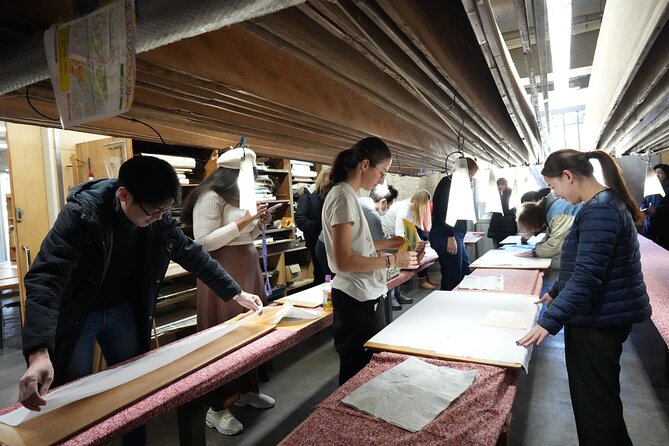
The dyeing portion is built around both explanation and hands-on time. You begin with an introduction to Edo Komon patterns used in samurai kamishimo. Even if you know zero Japanese craft terms, the point is clear: you’re learning how stencil-dye style imagery relates to samurai clothing, not just copying a pattern.
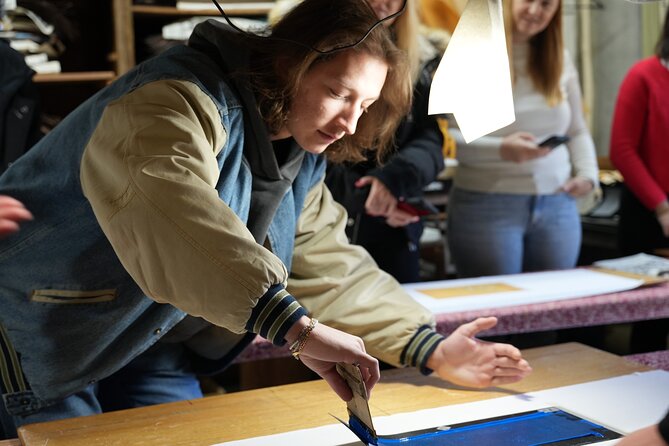
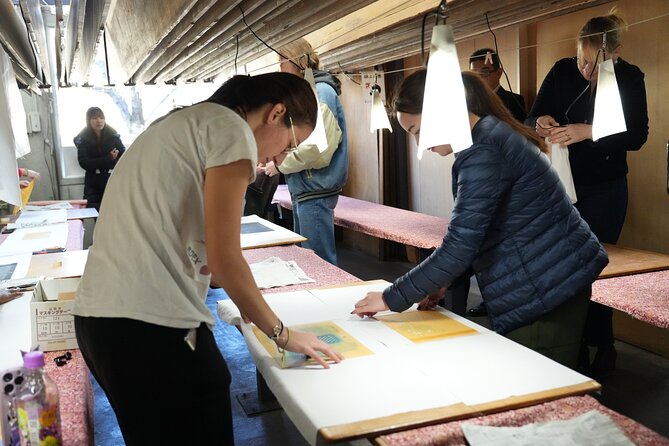
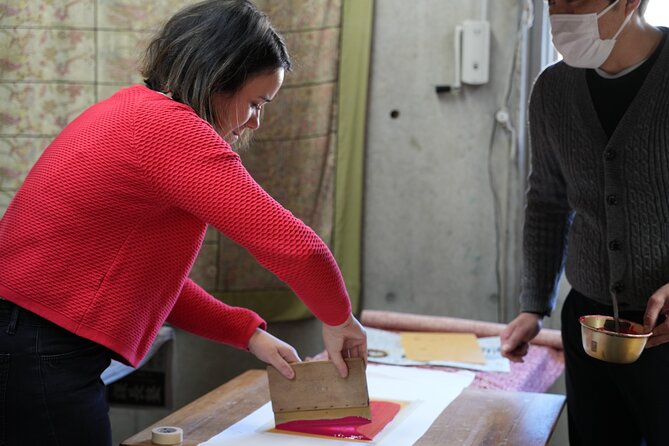
After that intro, you get the main practical session: tenugui dyeing for about 40 minutes. You work with instruction from artisans at the workshop, including Komon pattern dyeing. This is the part where you’ll want to slow down and follow along carefully, because dyeing-style craft is all about precision and patience.
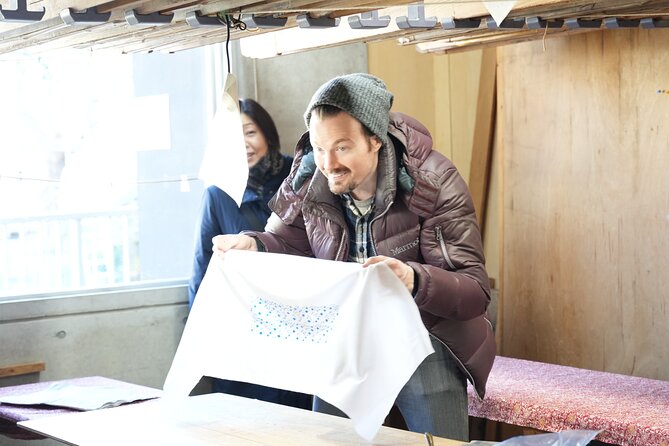
When you finish, you wrap your dyed tenugui as a headband and head off from 染の里おちあい. That wrapping step is small, but it’s satisfying. It turns the result from an “object you made” into something you immediately understand and can use.
What to expect: instruction-led dyeing, time to do the process yourself, then a take-it-with-you item made from your own work.
The 1-minute walk to the dojo: why the shift feels intentional
There’s a short transition built into the day. After dyeing, you depart the dyeing site, walk about one minute, and enter the dojo by taking off your shoes.
That brief in-between moment does more than move you down the street. It signals a change in pace and rules. In experiences like this, that matters because sword training is stricter than craft time. When the dojo environment starts on schedule, you stay focused and the whole group can settle quickly.
Samurai Sword Training at 武蔵国無外会: demo first, then you practice
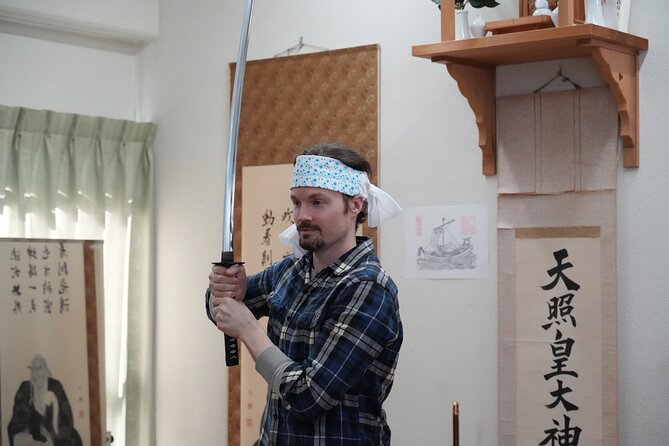
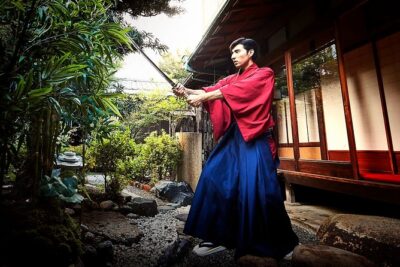
The sword portion is short but structured, and that’s a good thing. First comes a real sword demonstration for 15 minutes. Seeing the movement with a real blade helps you understand what you’re aiming at, without guessing.
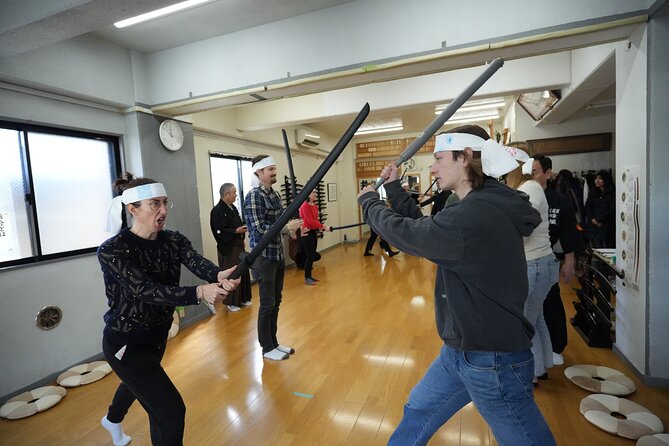
Then the instructors move into defensive actions using toy swords for about 15 minutes of explanation. This is a smart learning setup because it lowers the intimidation factor. You can focus on form and decision-making instead of worrying about the consequences of a real weapon.
Finally, you start sword training for about 30 minutes. That’s your time to put the instruction into motion and get corrections. With a maximum of 8 people in the group, you’re more likely to get feedback that fits what you’re doing, not generic advice meant for a larger crowd.
What to expect in practice: clear demo, then toy-sword defensive instruction, then guided training with time for you to participate.
Small-group attention: what max 8 really buys you
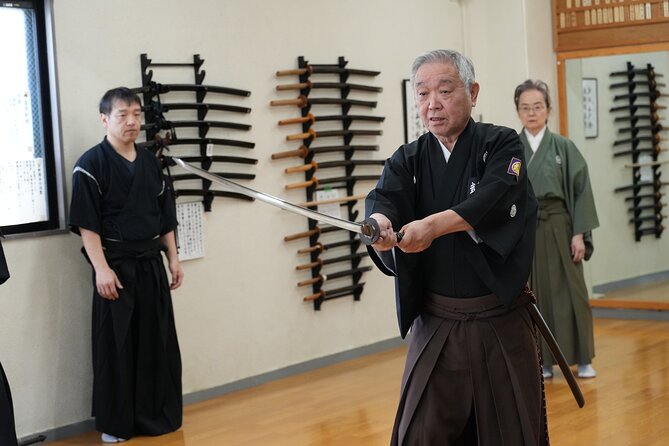
The group limit is 8, and it changes the vibe. In a small class, you’re not just watching from the sidelines. You’re more likely to ask questions when something doesn’t click, and the instructors can respond to you directly.
That matters in both halves of the day. In katazome work, small technique differences can change how a pattern lands. In dojo training, you need room to move and corrections that relate to your exact posture.
I like that the experience doesn’t try to cram in extra stops. Instead, it keeps the focus on instruction quality and hands-on time.
- Tokyo: Shinjuku Food Tour (13 Dishes at 4 Local Eateries)★ 5.0 · 6,603 reviews
- Tokyo Mt Fuji 5th St & Hakone Cruise Bus Tour w/Bullet Train★ 4.4 · 5,024 reviews
- Flagship 2-Hours Official Street Go-Kart Tour – Tokyo Bay Shop★ 5.0 · 4,974 reviews
- From Tokyo: Mount Fuji Full-Day Sightseeing Trip★ 4.5 · 4,970 reviews
- Tokyo: Hop-On Hop-Off Sightseeing Bus Ticket★ 3.9 · 4,207 reviews
The value equation: $97.73 for two full learning blocks
At $97.73 per person for about 2 hours, the price looks high if you think of it as a “try two activities” deal. But it reads differently when you see what you’re actually buying: a guided katazome dyeing session where you create a finished wearable, plus a dojo sword session with a real demonstration and your own practice time.
Also, both parts are instructor-led. You’re paying for guided time, not just access to a space. That’s why the duration works: roughly one hour for katazome and roughly one hour for sword training.
If you’re trying to build a Tokyo day that’s more than photos, this is the kind of value that adds up. You leave with an item you made (the headband) and a clearer understanding of how craft and warrior culture connect through the patterns used in samurai clothing.
Timing and flow: what the 10:00 am start means for your day
The tour starts at 10:00 am. That’s a friendly time for planning a Tokyo itinerary because you still have most of the day left afterward for other neighborhoods or food stops.
The experience includes a mobile ticket, and the tour begins at 染の里おちあい (Kamiochiai area). It ends at 武蔵国無外会 at the dojo. Knowing the end point matters because you can plan your next move without backtracking.
If you’re mapping your day, treat this like one complete block. The two activities are designed to connect: dye, then immediate switch to dojo training.
Meeting points you can actually find (and why it matters)
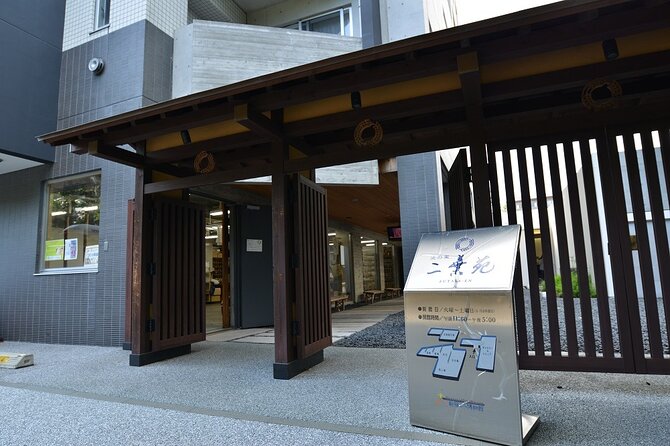
The start point is 染の里おちあい at 2-chōme-3-6 Kamiochiai, Shinjuku City, Tokyo 161-0034, Japan. The end point is 武蔵国無外会 at 2-chōme-4-6 Kamiochiai, Shinjuku City, Tokyo 161-0034, Japan.
Both are in the same Kamiochiai area, and the day includes only a short walk between stops. That reduces transportation stress and keeps you from losing time.
Practical tip: confirm directions before you go, then plan to arrive a few minutes early. In Japan, being on time is a form of respect, especially in places where shoes come off and instruction starts right away.
Who should book this Tokyo workshop?
This experience fits best if you want a hands-on cultural day with structure. You’ll enjoy it most if you like learning technique and understanding context, not just taking pictures.
It’s also a good match if you’re traveling with someone who has different interests. One person may love craft; the other may be more focused on martial arts. You get both in one compact schedule.
The tour says most travelers can participate, so it’s broadly accessible in terms of participation. Still, it’s worth thinking about comfort with small movements and following dojo rules, since you’ll be training after taking off your shoes.
Should you book Samurai Sword Training and Katazome Dyeing in Tokyo?
Book it if you want a Tokyo experience that mixes skill-building with culture and doesn’t stretch into a whole day of commuting. The strongest selling points are the finished headband you make, the fact that your dyeing work connects to samurai clothing patterns, and the clear training progression from demo to toy-sword defense to your own practice.
Skip it if you’re looking for long-form practice, deep craft study lasting multiple hours, or a tour that includes lots of extra sightseeing. This is a tight, structured workshop day, not a half-day wandering route.
If your goal is to come home with something you created and a better sense of how these Japanese traditions link together, this one is a solid choice.
FAQ
What is the duration of the experience?
It runs for about 2 hours.
What is the price per person?
The price is $97.73 per person.
How many people are in the group?
The maximum group size is 8 travelers.
Where does the tour start and end?
It starts at 染の里おちあい (2-chōme-3-6 Kamiochiai, Shinjuku City) and ends at 武蔵国無外会 (2-chōme-4-6 Kamiochiai, Shinjuku City).
What time does the tour start?
The start time is 10:00 am.
Do I make anything during the katazome part?
Yes. You dye a tenugui and then wrap it as a headband.
Is there any free cancellation?
Yes. You can cancel for a full refund up to 24 hours before the experience’s start time (local time).
More Tour Reviews in Tokyo
- Mt Fuji and Hakone 1-Day Bus Tour Return by Bullet Train
★ 5.0 · 26,383 reviews - 1-Day Tokyo Bus Tour
★ 5.0 · 14,250 reviews - Tokyo: teamLab Planets TOKYO Digital Art Museum Entry Ticket
★ 4.6 · 9,779 reviews - Mt Fuji & Hakone Cruise, Drum Show Bullet Train 1 Day from Tokyo
★ 4.0 · 7,413 reviews - Tokyo: Shinjuku Food Tour (13 Dishes at 4 Local Eateries)
★ 5.0 · 6,603 reviews
More Samurai and Ninja Sessions
- Tokyo: Samurai Ninja Museum Guided tour and Experience
★ 4.6 · 1,010 reviews - Tokyo: Samurai Sword & Archery Class from Samurai Descendant
★ 5.0 · 603 reviews - Best Samurai Experience in Tokyo
★ 5.0 · 458 reviews - Ninja Experience (Family Friendly) at Samurai Ninja Museum TOKYO
★ 5.0 · 441 reviews - Tokyo: Samurai Entertainment Night Show in Kanda Shrine
★ 4.6 · 417 reviews
Latest Tokyo reviews off our desk




Samurai & Ninja Classes, compared.
 ★ 4.6Samurai Ninja Museum Guided tour and ExperienceFrom $271,010 reviews
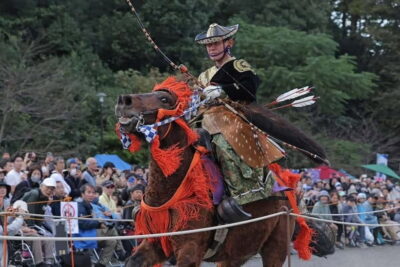 ★ 5.0Samurai Sword & Archery Class from Samurai DescendantFrom $193603 reviews
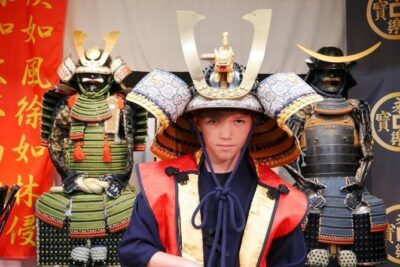 ★ 5.0Best Samurai Experience in TokyoFrom $65458 reviews
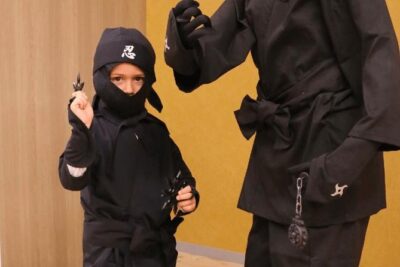 ★ 5.0Ninja Experience (Family Friendly) at Samurai Ninja Museum TOKYOFrom $47441 reviews
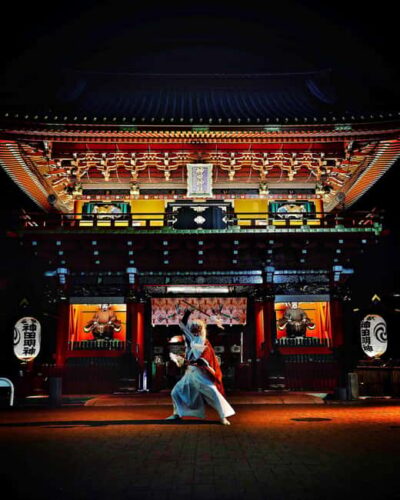 ★ 4.6Samurai Entertainment Night Show in Kanda ShrineFrom $41417 reviews
 ★ 4.2Ninja Kabuki PerformanceFrom $29330 reviews
 ★ 5.0Tokyo Sword Experience – includes Museum Ticket/Ninja ExperienceFrom $84314 reviews
 ★ 4.8Samurai Ninja Museum Asakusa: Samurai Sword Lesson & TourFrom $63306 reviews
Browse the lists this tour appears in