
Reviewed · ASAKUSA & SENSOJI TOURS
Asakusa: 1400-year history exploration
Asakusa feels like time travel. In a 3.5-hour loop, you’ll walk from the Sumida River to Senso-ji, then slip into Nakamise-dori and the Rokku district with a guide who ties old traditions to everyday Tokyo. I love that the focus stays on story, not just photos—Senso-ji is explained as a temple tied to two fisherman brothers and its role as Japan modernized.
What makes this tour practical (and fun) is the setup for actually enjoying the crowds. You get a small-group pace (max 8) and an earphone system so the guide’s voice stays clear while you move through busy lanes. I also like the included snack selection—things like melon pan, rice dumpling, rice crackers, and sweet puffed rice—because it turns sightseeing into small taste-tests you can’t easily plan on your own.
One possible drawback: on temple days, the area can get loud and packed, and timing matters. If you’re hoping for a quick hit—just gates, one temple photo, done—this 3.5-hour history walk may feel longer than you want.
In This Review
- Key points worth your attention
- 1400 years of Asakusa, measured in gates and streets
- From Azumabashi to the Sumida River view: a smart warm-up
- Asakusa Culture Tourist Information Center: where the guide helps you think
- Kaminarimon, Nakamise-dori, Hozomon: the approach is the lesson
- Senso-ji itself: the pagoda detail is the standout
- Asakusa Shrine: two religions on shared ground
- Denboin Street in Rokku: where the afternoon slows down
- Price and value for a 3.5-hour guided loop at $91
- Timing, crowds, and what to do so you don’t miss the audio
- Who this Asakusa history tour suits best
- Should you book the Asakusa 1400-year history exploration tour?
- FAQ
- How long is the Asakusa 1400-year history exploration tour?
- Where do you meet, and where does the tour end?
- What’s included in the tour price?
- Are there food and drinks included?
- What do you get for snacks on the tour?
- Can I get a full refund if I cancel?
Key points worth your attention
- A tight group capped at 8 keeps questions possible and the pace human.
- Earphone audio helps in crowd noise, as long as you stay near the group.
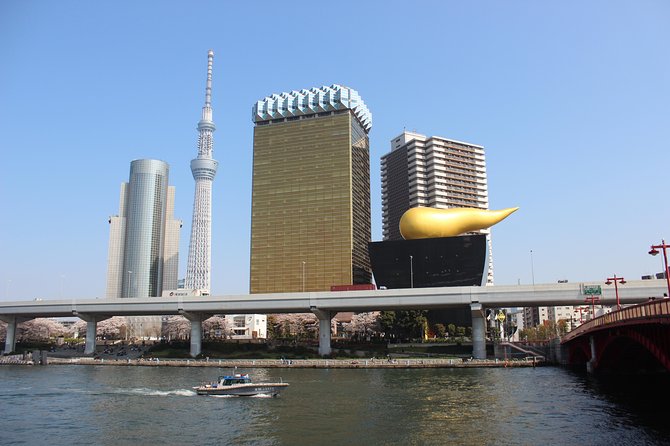
- Sumida River start gives you skyline context with views toward Tokyo Skytree and Asahi’s golden flame.
- Senso-ji isn’t rushed: you pass major gates and get specifics like the 53m pagoda built in 942.
- Nakamise-dori is timed for wandering, with stops built around sweets and street snacks.
- Rokku (Denboin Street) adds contrast by shifting from temple crowds to a traditional entertainment vibe.
1400 years of Asakusa, measured in gates and streets
Asakusa works because it layers time. You start at the Sumida River area, where the district’s origin is treated like more than a trivia fact—you’re basically learning how water, trade, and city life shaped this corner of Tokyo. Then you move toward Senso-ji through a chain of gates and approaches that makes the scale feel real.
The best part is that the tour keeps explaining what you’re seeing. Instead of just pointing at a landmark, your guide frames it with how the temple developed and how it connects to Japan’s wider shifts over time. That matters because Senso-ji is 1400 years old in the story sense, but the structures you see today have been rebuilt through disasters and community support.
And you’ll also notice the quiet “Tokyo skill” of the route. The itinerary is built to match how people actually walk this neighborhood: river views first, temple approach second, then snack-and-shop street time, and finally Rokku’s older entertainment lane feel.
More temple mornings in old Asakusa
- Tokyo: Japanese Dance Cabaret Theater Asakusa-Kaguwa Ticket
★ 4.8 · 2,270 reviews - Tokyo: Meiji Shrine, Asakusa, Skytree Bus Tour and Cruise
★ 4.7 · 1,986 reviews - Tokyo: Roll and Authentic Sushi Making Class in Asakusa
★ 4.9 · 1,957 reviews - Tokyo: Asakusa Walking Tour with Sensoji Temple Visit
★ 4.8 · 1,583 reviews
From Azumabashi to the Sumida River view: a smart warm-up
You meet at Burger King Asakusa Azumabashi, a practical landmark that’s easy to find using public transit. The walk begins by crossing into Asakusa’s “why” zone: the Sumida River.
At Stop 1 you’ll look across the river area from near Azumabashi bridge, and that’s where the skyline context shows up. If the light is right, Tokyo Skytree is part of the view. You’ll also spot Asahi Breweries’ headquarters and the well-known golden flame object. It’s a quick moment, but it helps you understand why this area still matters—modern Tokyo is literally layered over the older river identity.
What I’d do in your shoes: arrive a few minutes early, because this start is your chance to get your bearings without sprinting. If you’re traveling in warmer months, carry water; the tour advises bottled water since you’ll be walking.
Asakusa Culture Tourist Information Center: where the guide helps you think
Next you head to the Asakusa Culture Tourist Information Center for about 30 minutes. This isn’t the kind of stop that feels random. It’s the planning stop: you’re likely to get maps, orientation, and local context that makes the rest of the afternoon easier to navigate.
One detail I like here is that it’s presented as one of Asakusa’s newer sightseeing attractions (the building is described as 8 stories). In practice, this is where you stop guessing and start walking with better expectations.
The hidden value: when a guide points out what to look for later—street rhythms, what to prioritize in Rokku, and where food and drink fit in—you get better results from your time. And it’s also a chance to take a quick breath before Senso-ji crowds take over.
Kaminarimon, Nakamise-dori, Hozomon: the approach is the lesson
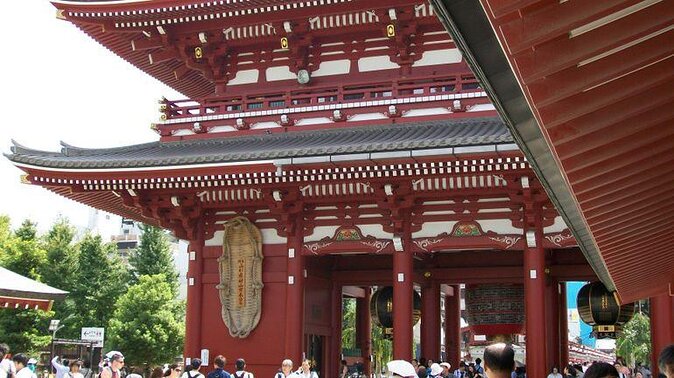
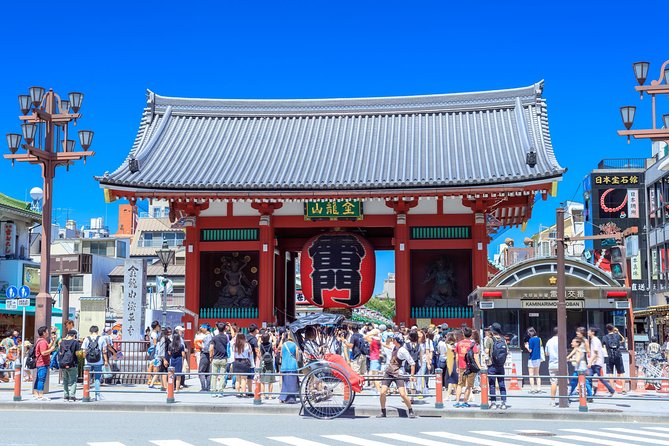
The first temple gate stop is Kaminarimon (Thunder Gate). You’ll spend about 15 minutes here, and the point isn’t just to see the famous red lantern—it’s to feel how this gate functions as the start of the temple approach. Statues, scale, and that sense of walking into a major cultural space all show up quickly.
Then comes Nakamise Shopping Street, the famous stretch connecting Kaminarimon to Senso-ji’s main gate. This is about 250 meters long and it’s structured like a combined shopping-and-snacking corridor. You’ll have around 30 minutes here, and the tour is set up so you don’t just browse randomly. Your guide shows you where to buy souvenirs and how to handle the food-stall situation without losing the flow of the walk.
A practical note: Nakamise is a place where you’ll want to pace yourself. If you try to do everything at once—photos, stalls, shopping, and eating—you’ll end up stressed. The guided snack sampling helps because it gives you a baseline of what’s worth tasting so you don’t feel like you must gamble on every booth.
After that, you pass Hozomon (Treasure-House Gate). This is another gate-to-temple moment, about 15 minutes, and it acts like a threshold into the heart of the Senso-ji compound. The tour’s structure makes sense: gates first, then the temple areas where details matter.
Senso-ji itself: the pagoda detail is the standout
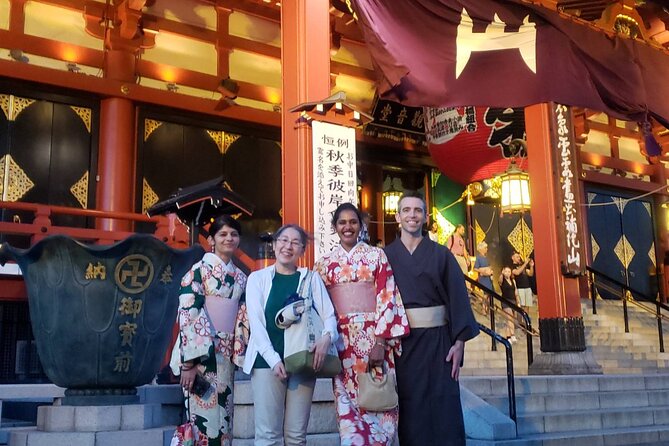
The main temple block is where the history becomes specific. You’ll spend about 45 minutes at Senso-ji, starting between Hozomon and the main hall area.
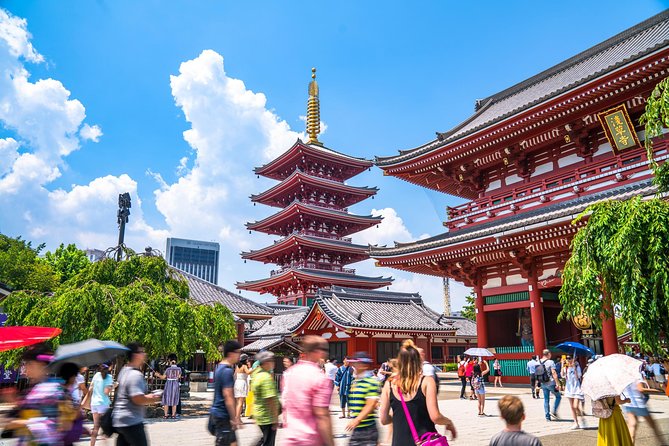
Here’s the detail I’d remember: the five-storied pagoda is described as the second-highest pagoda in Japan at 53 meters, built in 942, and it holds Buddha’s ashes. That kind of information changes how you look at the skyline of the complex. You’re not just seeing a tall structure—you’re seeing a long timeline.
Also keep an eye on how your guide uses the “and” approach: gates lead to major temple spots, temple spots lead to shrines, then the walk shifts into the older entertainment lanes. That pacing helps your brain connect religious history to daily neighborhood life instead of treating everything like separate photo stops.
One more reason this section works: it’s a built-in Q-and-A zone. Reviews highlight that small-group size lets people ask questions and actually get answers, not just listen to a lecture. If you’re the kind of person who wonders why things are the way they are, this is a great part of the tour to ask.
Readers also shortlisted these Tokyo bookings:
- Tokyo: Imperial Palace and Shogun Historical Walking Tour★ 5.0 · 2,251 reviews
- Tokyo: Imperial Palace Japanese History Walking Tour★ 4.9 · 987 reviews
- Yanaka Walking Tour: Historic and Traditional District of Tokyo★ 5.0 · 530 reviews
- Tokyo: Shinjuku Historical Walking Tour & Secret Backstreets★ 5.0 · 530 reviews
- Mt. Fuji Heritage Tour: Traditional Villages, Lakes & Shrine★ 4.5 · 509 reviews
Asakusa Shrine: two religions on shared ground
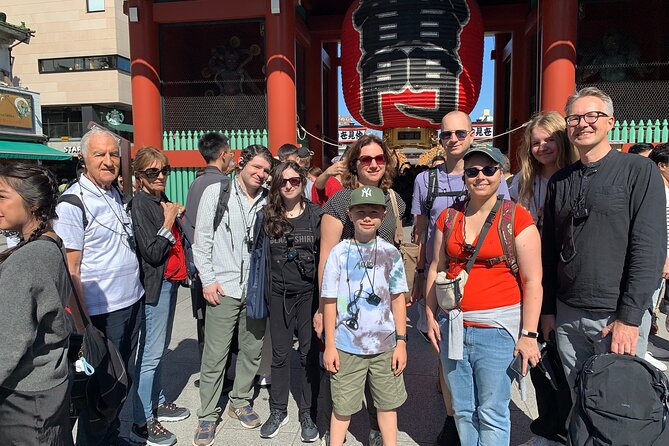
After the temple area, you move to Asakusa Shrine for about 15 minutes. This stop is included for a reason: you’ll learn about how a Buddhist temple and a Shinto shrine coexist in the same premises, sharing origins and worshipers.
It’s one of those Asakusa moments that feels surprising until you see it firsthand. The tour doesn’t just label it. It frames why this combination can make sense in Japanese religious life, so your takeaway is clearer than simple sightseeing.
If you want a small mindset shift: treat this stop as cultural education, not a checklist. The facts make the visuals easier to interpret—why people visit, what the spaces communicate, and how religious practice can fit inside a normal street-life neighborhood.
Denboin Street in Rokku: where the afternoon slows down
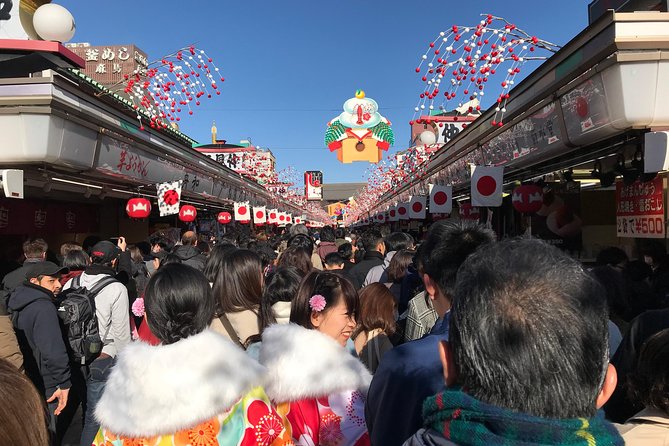
Finally, the tour escapes into Rokku via Denboin Street. You’ll get about 45 minutes here, and this is where Asakusa stops being only about temples and becomes about entertainment history.
The description sets the tone: it’s a traditional entertainment district that stays busy in atmosphere, even when you’re not looking at massive crowds. The guide helps you walk through the Meiji period into the present day, with stops along the way that connect past show culture to modern street life.
This is also where the tour’s “Tokyo local advice” part fits. You’ll get guidance on where to eat, drink, and shop in Rokku. That matters because Rokku is the kind of neighborhood where a little direction saves you time—and it can help you avoid tourist-only traps.
A bonus you might catch depending on timing: one group mentioned seeing a wedding ceremony. That’s not guaranteed, but it’s a reminder that this area can be lively in small, human ways beyond temples.
Price and value for a 3.5-hour guided loop at $91
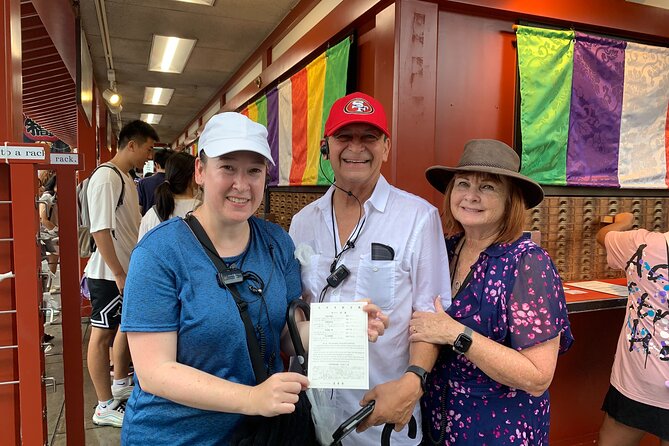
At $91.17 per person for around 3 hours 30 minutes, the real question is what you’re paying for. In this case, you’re not just buying access to sights. You’re buying:
- an English-speaking guide and structured pacing through gates and streets
- included Japanese sweet snacks (multiple items)
- an earphone system that helps you hear while walking
- an orientation stop at the Culture Tourist Information Center
If you go alone, you can of course wander Asakusa on your own. But you’ll still have the two friction points this tour solves: interpretation and timing. Without a guide, it’s easy to spend time in the wrong places or miss the “why” behind what you’re seeing—especially at Senso-ji where the details get better when someone points them out.
Also, the maximum group size of 8 is part of the value. Smaller groups don’t automatically mean better, but it does mean your questions are more likely to be answered. And the included snack tasting is genuinely useful for people who want to try things without turning the walk into an all-day food expedition.
Timing, crowds, and what to do so you don’t miss the audio
This tour runs in all weather, so plan for rain or heat. Wear footwear that can handle uneven sidewalks and temple-street crowd flow.
For listening: the earphone system is there so you can hear the guide securely from distance. The key is staying close enough to the group. One of the complaints tied to poor hearing wasn’t about the system failing—it was about distance from the group while resting or stepping away. So if you need a break, step back into the group flow before tuning fully into the talk.
For crowd stress: Asakusa around Senso-ji can be loud. If you’re sensitive to sound, go into it knowing it’s not a quiet museum environment. Use the included structure to your advantage: trust that your guide is moving you through the day in the order that works best for seeing and hearing something meaningful.
Who this Asakusa history tour suits best
This is a strong fit if you:
- want context at Senso-ji, not just a photo stop
- like walking neighborhoods where food and shopping feel natural (Nakamise and Rokku)
- appreciate a guide who answers questions and connects religion, history, and modern Tokyo life
- enjoy small taste-tests rather than full meals planned from scratch
It might be less ideal if you:
- want a super-short, low-effort route
- get annoyed when crowds slow your pace
- prefer only one type of stop (like only temples, with no shrine and no street wandering)
And one more practical tip: if you’re traveling with teenagers or older kids, this kind of structured story-and-sight schedule tends to land well. Reviews specifically called out that younger groups stayed interested when the guide connected the history to what they were actually looking at.
Should you book the Asakusa 1400-year history exploration tour?
Book it if you want to understand Asakusa while you’re in it. The combination of Sumida River context, Senso-ji specifics (including the pagoda detail), Nakamise snacks, and Rokku’s entertainment district walk gives you a well-rounded afternoon without needing to plan every step.
Skip it only if your idea of value is a fast checklist. This is a guided history-and-streets walk, so it rewards patience, good shoes, and a willingness to ask questions. If that sounds like you, this is an easy yes.
FAQ
How long is the Asakusa 1400-year history exploration tour?
It runs about 3 hours 30 minutes.
Where do you meet, and where does the tour end?
You meet at Burger King Asakusa Azumabashi in Taito City, near Kaminarimon, and the tour ends back at the meeting point.
What’s included in the tour price?
You get an English-speaking guide, an earphone guide system, and a selection of Japanese sweet snacks. A ticket for the Asakusa Culture Tourist Information Center is also included.
Are there food and drinks included?
Snack items are included, but food and drinks are not included beyond what’s specified.
What do you get for snacks on the tour?
The tour includes a selection of Japanese sweets and snack items such as melon pan, rice dumpling, rice cracker, and sweet puffed rice.
Can I get a full refund if I cancel?
Yes. Cancellation is free up to 24 hours in advance of the experience start time for a full refund.
More Historical Tours in Tokyo
- Tokyo: Imperial Palace and Shogun Historical Walking Tour
★ 5.0 · 2,251 reviews - Tokyo: Imperial Palace Japanese History Walking Tour
★ 4.9 · 987 reviews - Yanaka Walking Tour: Historic and Traditional District of Tokyo
★ 5.0 · 530 reviews - Tokyo: Shinjuku Historical Walking Tour & Secret Backstreets
★ 5.0 · 530 reviews - Mt. Fuji Heritage Tour: Traditional Villages, Lakes & Shrine
★ 4.5 · 509 reviews
More Tour Reviews in Tokyo
- Mt Fuji and Hakone 1-Day Bus Tour Return by Bullet Train
★ 5.0 · 26,383 reviews - 1-Day Tokyo Bus Tour
★ 5.0 · 14,250 reviews - Tokyo: teamLab Planets TOKYO Digital Art Museum Entry Ticket
★ 4.6 · 9,779 reviews - Mt Fuji & Hakone Cruise, Drum Show Bullet Train 1 Day from Tokyo
★ 4.0 · 7,413 reviews - Tokyo: Shinjuku Food Tour (13 Dishes at 4 Local Eateries)
★ 5.0 · 6,603 reviews
More Mornings in Old Asakusa
- Tokyo: Japanese Dance Cabaret Theater Asakusa-Kaguwa Ticket
★ 4.8 · 2,270 reviews - Tokyo: Meiji Shrine, Asakusa, Skytree Bus Tour and Cruise
★ 4.7 · 1,986 reviews - Tokyo: Roll and Authentic Sushi Making Class in Asakusa
★ 4.9 · 1,957 reviews - Tokyo: Asakusa Walking Tour with Sensoji Temple Visit
★ 4.8 · 1,583 reviews - Tokyo Asakusa Rickshaw Tour
★ 5.0 · 1,375 reviews
Latest Tokyo reviews off our desk






Asakusa & Sensoji Tours, compared.
 ★ 4.8Japanese Dance Cabaret Theater Asakusa-Kaguwa TicketFrom $492,270 reviews
 ★ 4.7Meiji Shrine, Asakusa, Skytree Bus Tour and CruiseFrom $1221,986 reviews
 ★ 4.9Roll and Authentic Sushi Making Class in AsakusaFrom $581,957 reviews
 ★ 4.8Asakusa Walking Tour with Sensoji Temple VisitFrom $221,583 reviews
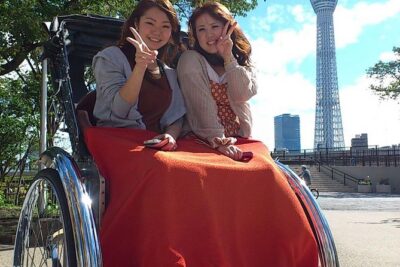 ★ 5.0Tokyo Asakusa Rickshaw TourFrom $421,375 reviews
 ★ 4.5Tokyo Panoramic 1 Day: Meiji Shrine, Asakusa, Odaiba and SKYTREE®From $851,222 reviews
 ★ 5.0Tokyo Go Kart: Asakusa, Skytree, and Akihabara **IDP MUST**From $99988 reviews
 ★ 4.7Asakusa, Skytree & Akhihabara Go-Kart City ExperienceFrom $96761 reviews
Browse the lists this tour appears in