
Reviewed · WORKSHOPS
Tokyo: 1.5-Hour Edo Kiriko Glass Cutting Workshop in Sumida
Glass cutting in Tokyo, with training included. This Edo Kiriko workshop in Sumida turns a traditional cut-glass craft into something you can actually try, not just watch. I like that you get hands-on tool practice before you cut your own design.
Two things I really appreciate are the calm, beginner-friendly setup and the clear support in English. You’ll see artisans working in the studio, then you’ll get a chance to try on test pieces first, which helps you understand the technique without panicking.
One consideration: guidance isn’t overly strict. If you’re very unsure at the start, you may want a bit more supervision than you’ll get in a small-group format.
In This Review
- Key Points I’d Plan Around
- Edo Kiriko Meets a Real Studio, Not a Classroom
- The 90-Minute Flow: From Watching to Cutting Your Own Pattern
- Choosing Your Piece: Drinking Glass vs. Lidded Container
- Tools, Safety, and Why Mistakes Don’t Sink the Mood
- Picking Glass in a Workshop Where Materials Change Daily
- The On-Site Edo Kiriko Shop: See How It Evolves
- Price and Value: Is $122 Reasonable for 90 Minutes?
- Who Should Book This Workshop in Tokyo (and Who Should Skip It)
- Practical Notes for Planning Your Visit
- Should You Book This Edo Kiriko Cutting Workshop?
- FAQ
- FAQ
- What is the duration of the Edo Kiriko glass cutting workshop in Sumida?
- How much does the workshop cost?
- Where does the workshop take place?
- What will I make during the workshop?
- What is the minimum age to join?
- Can companions watch without cutting?
- Is the workshop suitable for small children?
- What is included in the workshop price?
- Do I need to speak Japanese?
- Are pets allowed and is photography allowed?
- Can I cancel for a refund?
Key Points I’d Plan Around
- Sumida studio access: you’re in a working workshop, watching artisans cut as part of the experience
- Practice before the real cut: you work with tools on test glass/container pieces first
- You choose the glass daily: your material is one-of-a-kind and changes day to day
- Adults and middle school make drinking glass: kids make a lidded container instead
- Small group of up to 4: more attention than big tours, while still feeling relaxed
- Take-home keepsake: you leave with the piece you cut, plus you browse the on-site shop afterward
Edo Kiriko Meets a Real Studio, Not a Classroom
Edo Kiriko is Tokyo’s traditional cut-glass craft, and the best part of this workshop is that it doesn’t feel staged. You’ll step into an active studio in Sumida where craftspeople are engraving and cutting glass as you arrive. That matters because it puts you close to the process, not just the results.
The workshop is designed around what you can do in 90 minutes: watch first, then practice, then cut your own pattern with staff guidance. I like that the pace respects beginners. There’s a short practice session that helps you learn how the tools behave, how careful you need to be, and what to focus on.
Also, the format is small—limited to 4 participants. That helps the experience feel manageable and keeps the atmosphere relaxed rather than rushed. It’s a nice change from activities where you’re handed a worksheet and told to “copy the sample.”
Readers also shortlisted these Tokyo bookings:
- Sushi Making Tokyo Roll and Authentic Japanese Sushi Class
★ 5.0 · 3,971 reviews - Tokyo: Roll and Authentic Sushi Making Class in Asakusa
★ 4.9 · 1,957 reviews - Tokyo Shinjuku Chopsticks Making Class
★ 5.0 · 1,763 reviews - Tokyo: Sushi Making Class in a Happi Coat near a Famous Spot
★ 4.9 · 1,377 reviews
The 90-Minute Flow: From Watching to Cutting Your Own Pattern
The workshop runs like a tight little sequence, and each part has a job to do.
First, you’ll observe Edo Kiriko craftsmen at work in the studio. You’re watching real technique—how they handle the glass, how they aim, and how they move with control. This is useful even before you touch tools, because you learn what “accuracy” means in this context.
Next comes the practical part: a practice session with tools. You won’t start immediately on your final piece. That training time is key for first-timers. It lets you get comfortable with the motion and the feel of cutting without the pressure of ruining your actual glass.
Then you choose your glass. Your selection comes from a stock that changes daily, and each piece is different. That daily change is worth noting because it affects the look of your finished item; you’re not picking from a static menu that never varies.
After you’ve selected your material, staff guide you as you cut your own design. Your pattern choice depends on your age group (more on that below). The goal is that by the end you have a finished Edo Kiriko keepsake you can take home.
Finally, you’ll visit the Edo Kiriko shop on site. This isn’t just a sales stop that interrupts your workshop. It’s part of understanding the craft: you can compare what you made with what’s already been fully refined, and see how Edo Kiriko shows up in everyday objects and modern collaborations.
Choosing Your Piece: Drinking Glass vs. Lidded Container
The workshop is built for different skill levels, and the output changes based on age.
For adults and middle school students, the cutting experience is a drinking glass. If you’re a grown-up who wants a functional souvenir, this is the best match. You’re creating something you can actually use, which makes the craft feel more practical than a flat decorative item.
For elementary school children, the activity is a lidded container. This gives younger participants an age-appropriate project while still keeping the core idea: select a glass, cut a pattern, and finish with a real keepsake.
The minimum age to join is 4th grade elementary (with an adult companion). You’ll also want to know the workshop isn’t suitable for children under 9. If you’re traveling with a younger kid, plan a different activity so everyone stays comfortable with the pace and focus required.
One more detail that’s easy to miss: adults must accompany children. Companions may observe without cutting, which is helpful if you’ve got a mixed group of ages and not everyone is ready to use tools.
Tools, Safety, and Why Mistakes Don’t Sink the Mood
In glass cutting, technique matters. But the vibe of the workshop matters too, and that’s a big reason people enjoy it.
You’re taught safe ways to handle and cut glass, and you get time to practice first. That “practice round” is not filler—it’s how you learn to control your focus and see what a correct motion feels like.
In the studio environment, the mood tends to be supportive. People are given room to experiment rather than being shut down for errors. That’s especially important for beginners, because the first few tries are always awkward in handcrafts like this.
That said, you should go in expecting that the workshop is not overly tightly controlled. Small-group format is relaxing, but it can mean you don’t get minute-by-minute corrections for every single step. If you’re the type who learns best with constant oversight, you might feel like you’d benefit from a bit more help early on. The good news is that staff guidance is part of the experience, and you’re not left totally on your own.
Picking Glass in a Workshop Where Materials Change Daily
One of the most fun parts here is that you select your own glass from a changing stock. Edo Kiriko pieces aren’t all identical; the material you choose affects the look of the final work.
Because the stock changes day to day, your workshop experience isn’t a clone of someone else’s. Even if two people pick similar motifs, the glass itself can be different. That’s what makes it feel personal rather than pre-packaged.
I also like that the selection happens after you observe artisans and do practice. That ordering helps your decision. You’re not choosing blindly—you’ve already seen how the craft looks when it’s done right, and you’ve already tested how your tools work on practice pieces.
- Tokyo: Shinjuku Food Tour (13 Dishes at 4 Local Eateries)★ 5.0 · 6,603 reviews
- Tokyo Mt Fuji 5th St & Hakone Cruise Bus Tour w/Bullet Train★ 4.4 · 5,024 reviews
- Flagship 2-Hours Official Street Go-Kart Tour – Tokyo Bay Shop★ 5.0 · 4,974 reviews
- From Tokyo: Mount Fuji Full-Day Sightseeing Trip★ 4.5 · 4,970 reviews
- Tokyo: Hop-On Hop-Off Sightseeing Bus Ticket★ 3.9 · 4,207 reviews
The On-Site Edo Kiriko Shop: See How It Evolves
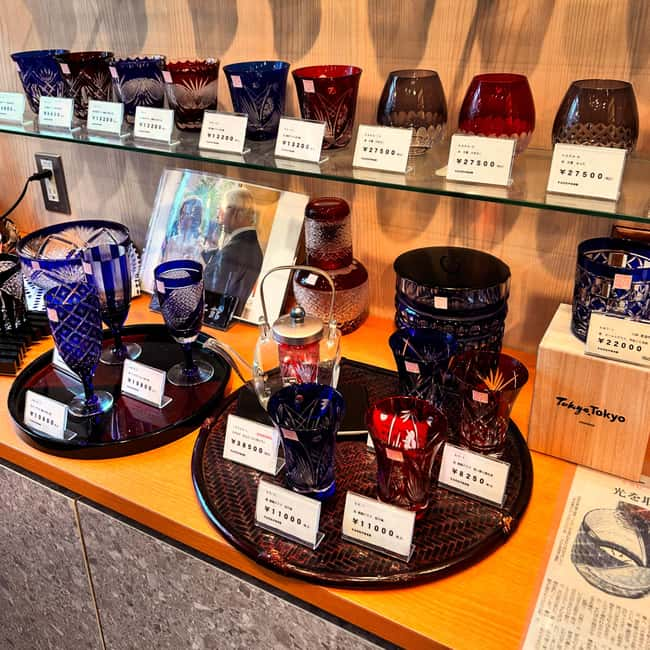
After you finish cutting, you’ll browse the Edo Kiriko shop right there in the studio. This is where you get context for what makes cut glass a premium craft.
You’ll see items with classic motifs, but you’ll also notice modern design directions. The shop includes colorful pieces and even brand collaborations. The point isn’t that you’ll somehow become an Edo Kiriko expert in one afternoon—it’s that you can connect your hands-on experience to what’s sold in Japan.
For me, it’s a helpful reality check. When you see how many steps go into creating polished items, the higher prices start to make more sense. If you’re trying to decide whether your workshop fee is worth it, the shop helps you compare “what you can do in 90 minutes” versus “what artisans refine over time.”
And if you’re shopping for gifts, you’ll likely spot pieces that fit your style better than souvenir magnets. Just remember: purchases at the shop are not included.
Price and Value: Is $122 Reasonable for 90 Minutes?
At $122 per person for about 90 minutes, this isn’t a budget activity. But the price starts to feel more reasonable when you look at what you actually get.
You’re paying for:
- A guided workshop with English-speaking support
- A real studio setting where you can watch artisans work
- A practice session with tools (not just “try once and hope”)
- A hands-on glass-cutting result you keep
- Small-group attention limited to 4 participants
The biggest value factor is the take-home piece. If you’re paying to make something and bring it home, you’re not just buying entertainment—you’re buying a souvenir that’s personal and functional (for the glass option).
Compare that to cheaper craft activities that give you a generic item or a quick demo. Here, you’re doing the cutting work itself. You’re also learning the craft’s rhythm: observe, practice, cut, finish. That learning time has weight.
Is it overpriced compared with buying a mass-produced glass souvenir? Sure. But Edo Kiriko isn’t mass-produced, and the workshop lets you feel why that matters.
Who Should Book This Workshop in Tokyo (and Who Should Skip It)
This is a great fit if you want a hands-on activity in Tokyo that stays grounded in real technique.
You’ll probably love it if:
- You like crafts and want to understand the process, not just the photo
- You want a distinctive take-home gift
- You’re okay with a short, structured 90-minute session
- You travel with kids who are at least in upper elementary age (and for children, an adult companion is required)
It may not be the best fit if:
- You’re traveling with a very young child (not suitable for children under 9)
- You need constant, hands-on supervision at every step
- You’re expecting an ultra-formal class with lots of verbal instruction (the workshop is more practice-and-do)
Also note a couple of practical limits: pets aren’t allowed, and the workshop is indoors. Photography is allowed in designated areas, so you can capture your progress without turning it into a distraction.
Practical Notes for Planning Your Visit
This workshop runs indoors in Sumida, and it’s guided with Japanese and English support. The group is small, capped at 4 participants, which means you should expect a more personal pace than a larger tour.
The language support is especially helpful if your Japanese is limited. You’ll have English-speaking assistance and translation, which matters because tool work depends on clear instruction.
If you’re visiting with family, plan around the age split:
- Adults and middle school: drinking glass
- Elementary: lidded container
And remember the adult companionship rule for children.
One more thing: you’ll be cutting and handling tools as part of the experience. That’s not a casual stroll. Wear your “I can focus for 90 minutes” energy, and you’ll get more out of it.
Should You Book This Edo Kiriko Cutting Workshop?
If you want a memorable Tokyo activity that blends craft, instruction, and a take-home result, I think this workshop is an easy yes. The mix of watching artisans, practicing with tools, and then cutting your own piece is exactly the structure that turns a beginner into someone who understands the craft quickly.
I’d book it if you value:
- Hands-on making in a real studio setting
- A small group format
- A practical souvenir you keep (especially if you’re making the drinking glass)
Skip it only if your group includes children under 9, if you can’t attend with the adult companion rule, or if you’re looking for a highly guided, step-by-step experience with heavy supervision at every moment.
FAQ
FAQ
What is the duration of the Edo Kiriko glass cutting workshop in Sumida?
The workshop lasts about 90 minutes.
How much does the workshop cost?
The price is listed at $122 per person.
Where does the workshop take place?
It takes place in Sumida, Tokyo, in an Edo Kiriko glass studio.
What will I make during the workshop?
Adults and middle school students cut a drinking glass. Elementary school children cut a lidded container.
What is the minimum age to join?
Participants must be from 4th grade elementary school and older, with an adult companion for children.
Can companions watch without cutting?
Yes. Adults must accompany children, but companions may observe without participating in cutting.
Is the workshop suitable for small children?
It is not suitable for children under 9.
What is included in the workshop price?
Included are the 1.5-hour guided workshop, a practice session with tools, the glass-cutting experience, observation of artisans, and English-speaking support.
Do I need to speak Japanese?
No. The workshop has Japanese and English support, including English translation.
Are pets allowed and is photography allowed?
Pets are not allowed. Photography is allowed in designated areas.
Can I cancel for a refund?
Yes. Free cancellation is available up to 24 hours in advance for a full refund.
More Workshops in Tokyo
- Sushi Making Tokyo Roll and Authentic Japanese Sushi Class
★ 5.0 · 3,971 reviews - Tokyo: Roll and Authentic Sushi Making Class in Asakusa
★ 4.9 · 1,957 reviews - Tokyo Shinjuku Chopsticks Making Class
★ 5.0 · 1,763 reviews - Tokyo: Sushi Making Class in a Happi Coat near a Famous Spot
★ 4.9 · 1,377 reviews - Chopstick Making Workshop in Ginza
★ 4.8 · 1,366 reviews
More Tour Reviews in Tokyo
- Mt Fuji and Hakone 1-Day Bus Tour Return by Bullet Train
★ 5.0 · 26,383 reviews - 1-Day Tokyo Bus Tour
★ 5.0 · 14,250 reviews - Tokyo: teamLab Planets TOKYO Digital Art Museum Entry Ticket
★ 4.6 · 9,779 reviews - Mt Fuji & Hakone Cruise, Drum Show Bullet Train 1 Day from Tokyo
★ 4.0 · 7,413 reviews - Tokyo: Shinjuku Food Tour (13 Dishes at 4 Local Eateries)
★ 5.0 · 6,603 reviews
Latest Tokyo reviews off our desk






Workshops, compared.
 ★ 5.0Sushi Making Tokyo Roll and Authentic Japanese Sushi ClassFrom $593,971 reviews
 ★ 4.9Roll and Authentic Sushi Making Class in AsakusaFrom $581,957 reviews
 ★ 5.0Tokyo Shinjuku Chopsticks Making ClassFrom $201,763 reviews
 ★ 4.9Sushi Making Class in a Happi Coat near a Famous SpotFrom $421,377 reviews
 ★ 4.8Chopstick Making Workshop in GinzaFrom $251,366 reviews
 ★ 5.0Tokyo Sushi Making Class in Tsukiji with Professional ChefFrom $491,177 reviews
 ★ 5.0Ramen & Gyoza Cooking Class in Tokyo with Local Supermarket VisitFrom $122823 reviews
 ★ 5.0Matcha Making Class in Tokyo with Authentic Japanese Sweets SetFrom $21744 reviews
Browse the lists this tour appears in