
Reviewed · CRAFT & ARTISAN WORKSHOPS
Tokyo: Calligraphy on Kanji Fan & Scroll with Drink
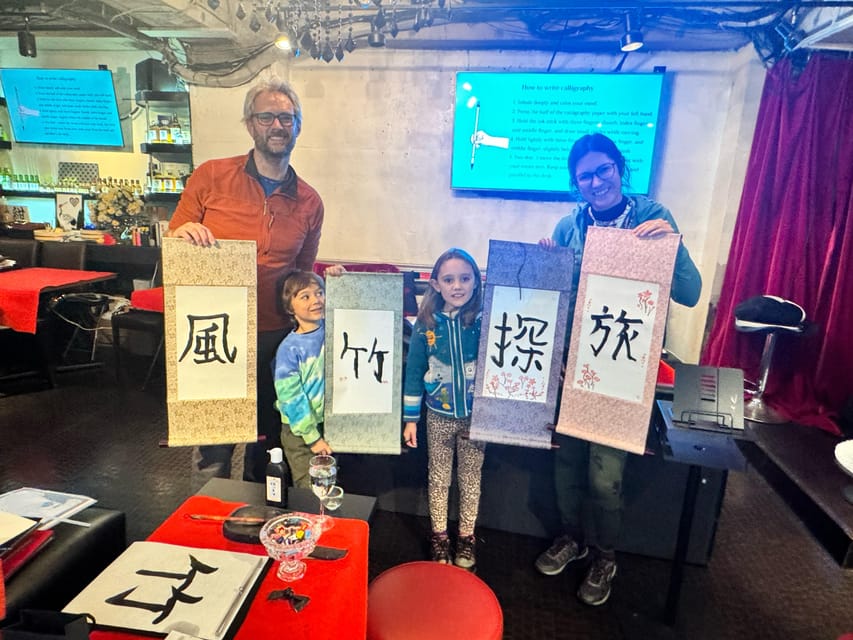
Brushstrokes calm you faster than you expect. In Roppongi at Shodo Cafe 7557, you do Japanese calligraphy at an easy pace with a drink (like matcha) included, then walk out with real artwork and personal stamps. I like that you get guided brush-stroke practice and that you can write a meaningful kanji character instead of copying something generic. One drawback to plan for: you are making several items in a short session, so it helps to keep your expectations simple and just follow Kana and Tomi step by step.
You start with basics and end with souvenirs you can actually use. That mix is why this feels like good value, not a quick photo-op. Eighty minutes can go by fast, especially if you are still figuring out how the brush behaves, but the instructors are patient and you get multiple chances to get it right.
In This Review
- Key points before you go
- A calm calligraphy studio in Roppongi: Shodo Cafe 7557 basics
- What you learn in 80 minutes: brush strokes with a purpose
- Writing your name and a favorite kanji on a fan and hanging scroll
- A small add-on that makes it feel extra personal
- Make your own hanko stamp: the souvenir you will actually use
- Matcha, tea, coffee, soda, or beer: a break that stays part of the lesson
- What you take home: the full set of kanji souvenirs
- Price and value: why $53 feels fair for this kind of Tokyo activity
- Who should book this workshop, and who should skip it
- Practical tips so your calligraphy turns out better
- Should you book Shodo Cafe 7557 in Roppongi?
- FAQ
- How long is the calligraphy workshop?
- Where is the meeting point?
- What language are the instructions in?
- What can I write on the fan and hanging scroll?
- Do I get to make a hanko stamp?
- What drinks are included?
- What souvenirs will I take home?
- Can I book and pay later?
- Is free cancellation available?
- Is this activity wheelchair accessible?
- Is there an age limit?
Key points before you go
- Near Roppongi Station: easy to reach, about a few minutes from Exit 7 on the Toei Oedo Line.
- English instruction: Kana and Tomi guide you through tools, strokes, and what each character should feel like.
- Two calligraphy projects: a kanji uchiwa (paper fan) and a kakejiku (hanging scroll), both personalized.
- A hanko you can take home: you create a hiragana hanko stamp of your name as a real keepsake.
- More than paper gifts: you also receive a kanji keychain, coaster, pouch, and tote bag with kanji designs.
- Meaning matters: you learn the basic philosophy behind brushwork and the role of each stroke.
A calm calligraphy studio in Roppongi: Shodo Cafe 7557 basics
If your Tokyo plan feels too packed, this is a smart reset. Shodo Cafe 7557 sits in the Crest Roppongi Building, and the walk in is straightforward. From Roppongi Station (Toei Oedo Line, Exit 7), you cross toward FamilyMart, turn right toward the National Art Center, then follow Bijutsukan Dori. You should spot a large crane sign on your left, and the studio is on the 2nd floor.
Why I like this location choice for you: Roppongi is already central, so you are not budgeting half your day for transit. Also, the timing tends to work well for a “soft landing” after shopping, museums, or a dinner that ran late.
The workshop vibe is intentionally quiet and hands-on. You are not learning calligraphy like a lecture. You are holding the tools, watching the strokes, then trying again. That’s the fastest route to feeling the art instead of just reading about it.
More hands-on studios our readers booked
- Tokyo Shinjuku Chopsticks Making Class
★ 5.0 · 1,763 reviews - Chopstick Making Workshop in Ginza
★ 4.8 · 1,366 reviews - Kintsugi Experience: Art of Golden Joinery in Tokyo
★ 5.0 · 467 reviews - Tokyo Chopstick Making Workshop with Artisan
★ 5.0 · 466 reviews
What you learn in 80 minutes: brush strokes with a purpose
This class is built around a practical starting point: basic brush strokes and how to control them. Japanese calligraphy, shodō, is often described as meditative, but here you learn the meditative part through technique. Your instructors explain what each stroke is supposed to do, then you practice until your hand stops feeling totally lost.
In a workshop like this, your biggest challenge is usually not memory. It is force and direction: how quickly you pull the brush, how much pressure you put down, and when you lift cleanly. That is why the “slow enough to learn, fast enough to finish” structure matters. You get guidance in real time, and the goal is confidence with your own written character.
You also learn the meaning behind what you are writing. You are making choices: your name or a favorite word in kanji. That turns the lesson from skill training into something personal.
I especially appreciate that the teachers make room for beginners. If you love kanji already, you still benefit, because the focus stays on brushwork mechanics and not just “look pretty.” If you are brand new, you still end with usable outcomes, not just a worksheet.
Writing your name and a favorite kanji on a fan and hanging scroll
Your main art projects are two classic forms.
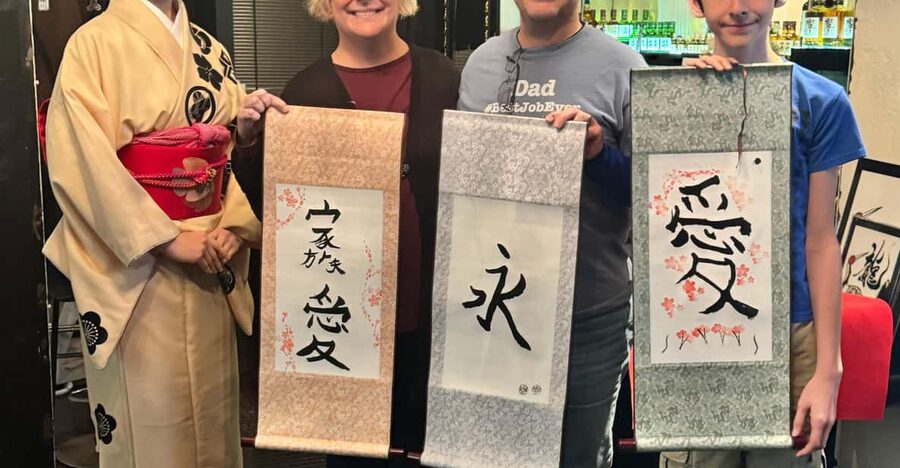
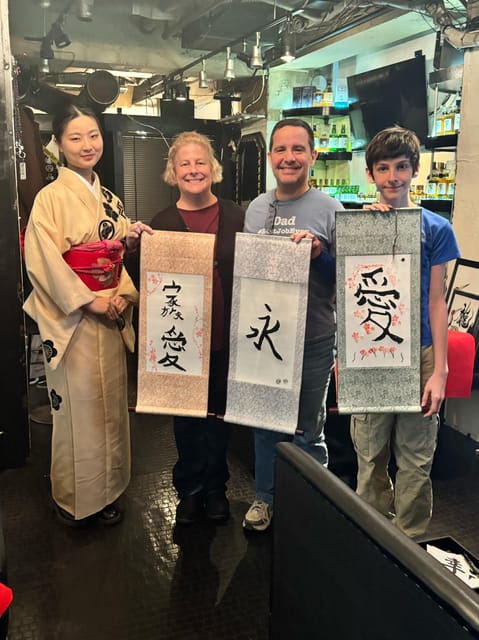
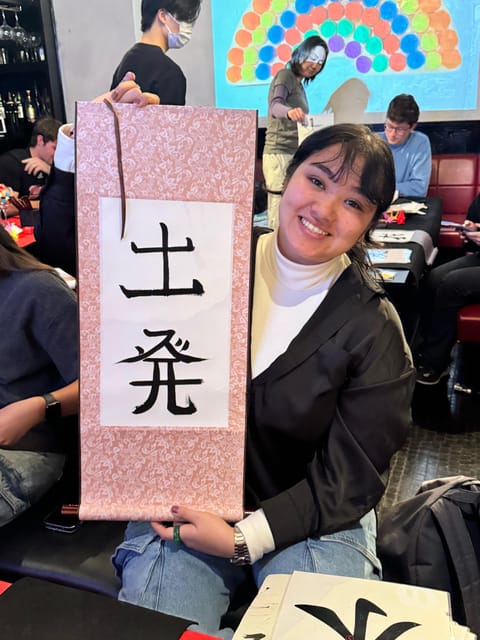
First, you write your chosen kanji on a uchiwa, a traditional paper fan. Second, you create a kakejiku, the hanging scroll format you often see in Japanese homes and culture displays. Getting to do both is a big deal because they force different thinking. A fan asks you to manage the character’s shape across a smaller, slightly curved surface. A hanging scroll asks for balance and placement that feels more “vertical and framed.”
Here’s how to get the best result: don’t aim for perfect calligraphy at first. Aim for steady control. On your first practice attempts, treat it like training your hand. As you repeat, your strokes get cleaner, and the character starts to look intentional.
You also have the option to write your name in kanji or use a translated version of what you want to express. That matters because it helps your souvenir feel like it belongs to you.
And yes, you end up with original artwork. That is what makes this experience feel like a real cultural purchase, not a generic activity token.
A small add-on that makes it feel extra personal
When you book, you provide participant names in English. If you share your names in advance, the studio can prepare a special bonus: an animated video of your names in kanji. In practice, this turns a souvenir into a story you can replay later.
Make your own hanko stamp: the souvenir you will actually use
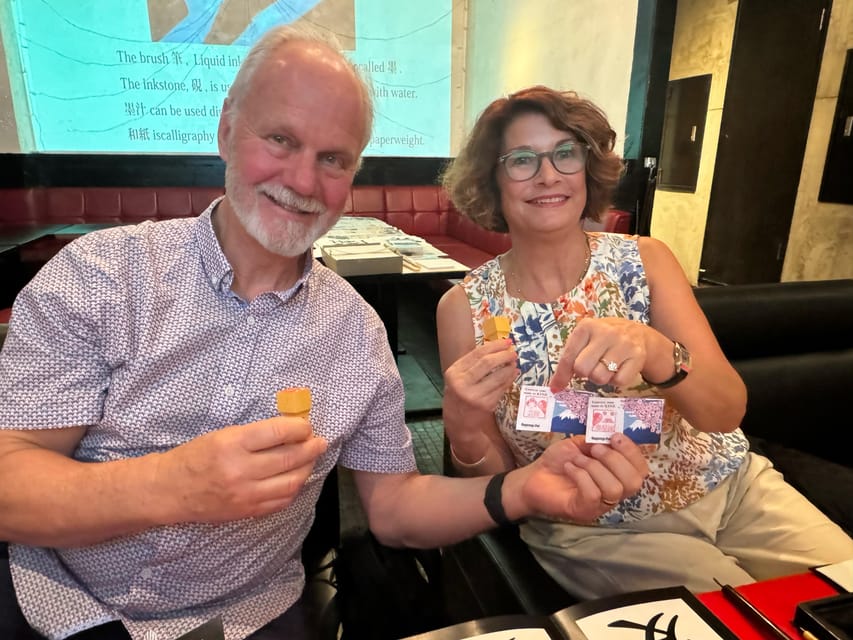
A lot of workshops give you “nice stuff.” This one gives you something with function. You create a hanko stamp using your name in hiragana. Even if you never stamp official documents, you will still use it for gifts, labels, journaling, or just as a conversation piece.
The value here is that the stamp connects directly to your identity. You are not choosing a random design. You are creating a mark that matches your name. That makes the whole workshop feel more grounded.
You also take home multiple kanji-themed items beyond the stamp, like a keychain, coaster, pouch, and tote bag. So if you are traveling light and you want souvenirs that are easy to store, you are covered.
- Tokyo: Shinjuku Food Tour (13 Dishes at 4 Local Eateries)★ 5.0 · 6,603 reviews
- Tokyo Mt Fuji 5th St & Hakone Cruise Bus Tour w/Bullet Train★ 4.4 · 5,024 reviews
- Flagship 2-Hours Official Street Go-Kart Tour – Tokyo Bay Shop★ 5.0 · 4,974 reviews
- From Tokyo: Mount Fuji Full-Day Sightseeing Trip★ 4.5 · 4,970 reviews
- Tokyo: Hop-On Hop-Off Sightseeing Bus Ticket★ 3.9 · 4,207 reviews
Matcha, tea, coffee, soda, or beer: a break that stays part of the lesson
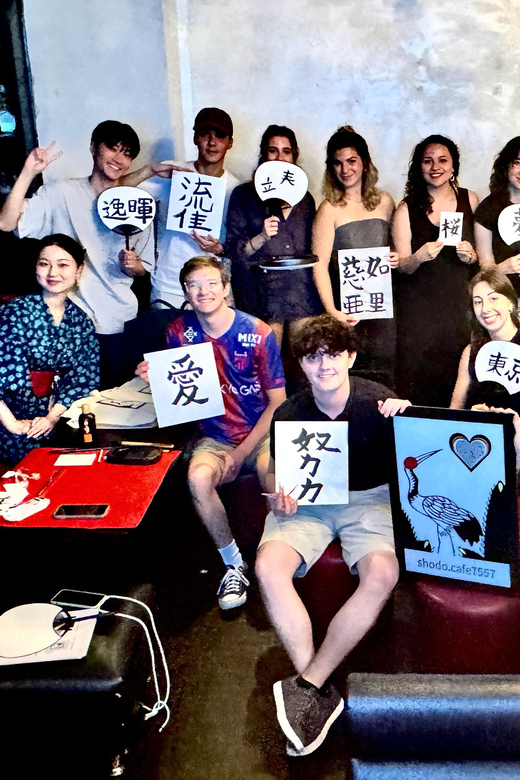
Included drinks help you relax your grip—literally. Your lesson includes a drink such as matcha latte, green tea, coffee, soda, or beer.
It sounds small, but it matters in a hands-on workshop. You are dipping ink, wiping tools, and focusing on stroke consistency. A warm drink like matcha latte can make you feel calmer while you practice. If you prefer something non-tea, your options make it easier to keep the experience comfortable.
Practical tip: if you choose a drink that you tend to sip slowly, it can help you avoid rushing your practice when your turn comes. The workshop is timed, so staying relaxed is part of getting good results.
What you take home: the full set of kanji souvenirs
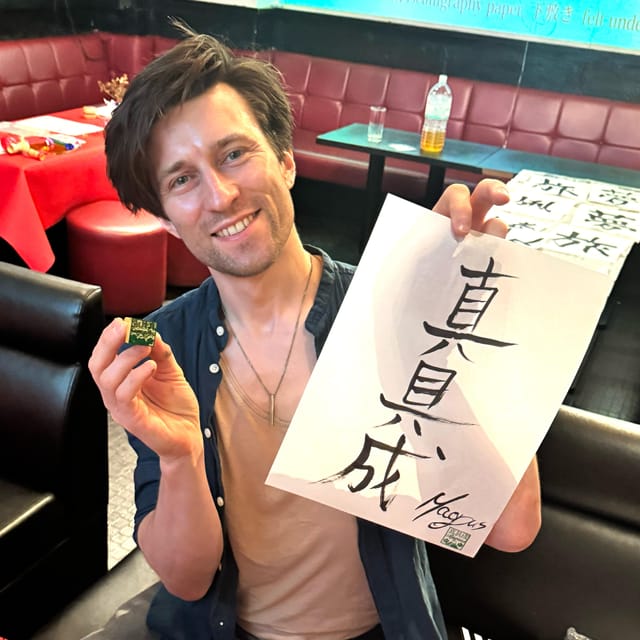
You leave with several items, and they are not all just “decor.” The studio provides:
- Your personalized kakejiku (hanging scroll)
- Your personalized uchiwa (kanji fan)
- A hiragana hanko stamp of your name
- A kanji tote bag
- A kanji keychain
- A kanji coaster
- A kanji pouch
From a value perspective, this is why the price makes sense. You are not paying only for instruction. You are paying for materials, tools, and the finished products you can bring home and use immediately.
Also, the fact that you create multiple items in different formats makes each one feel more like a distinct souvenir rather than the same artwork copied five ways.
Price and value: why $53 feels fair for this kind of Tokyo activity
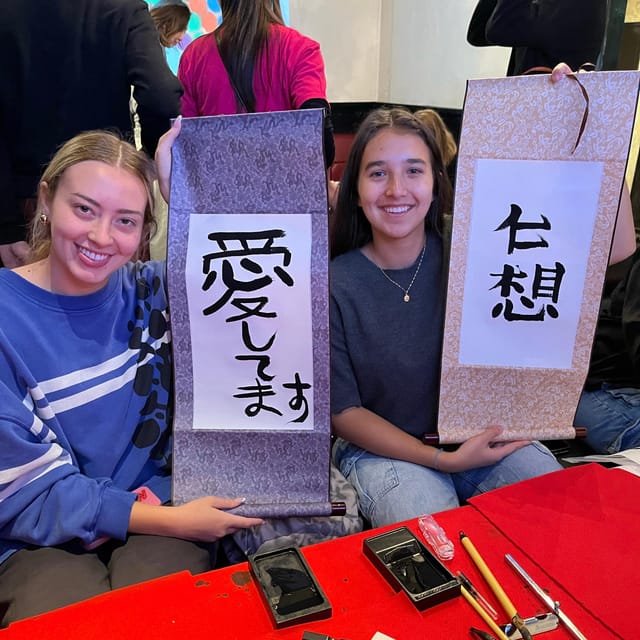
At about $53 per person for an 80-minute workshop, this lands in the “good value” range because you get three layers of payoff.
- Instruction and practice time: you learn basic strokes and brush behavior with English guidance.
- Personalized outcomes: you make your own calligraphy on the fan and scroll, plus a hanko stamp.
- A bundle of take-home goods: tote bag, keychain, coaster, pouch, plus your artwork.
If you compare this to the cost of buying calligraphy souvenirs in Tokyo, the math often becomes easier once you notice what is included. You are walking out with items that would cost extra if you were buying them one by one. Here, you create the core pieces yourself.
This is also a good buy if you want an experience that works for more than one person at once—there is something satisfying about sharing the same “make it together” moment.
Who should book this workshop, and who should skip it
This experience is a strong fit if you want a hands-on cultural activity in central Tokyo that does not require prior knowledge. It is designed for beginners and kanji lovers, which is exactly the mix you want if you are traveling with someone who is artistic but not sure where to start.
It is also a good rainy-day option. You are indoors on the 2nd floor, and the schedule is self-contained.
One clear limitation: it is not suitable for people over 95 years. If you are within that range, you may want to consider your stamina and fine-motor control for brushwork.
If you hate structured activities with instructions, this may not be your style. This workshop is guided and step-based, and the whole point is slow repetition.
Practical tips so your calligraphy turns out better
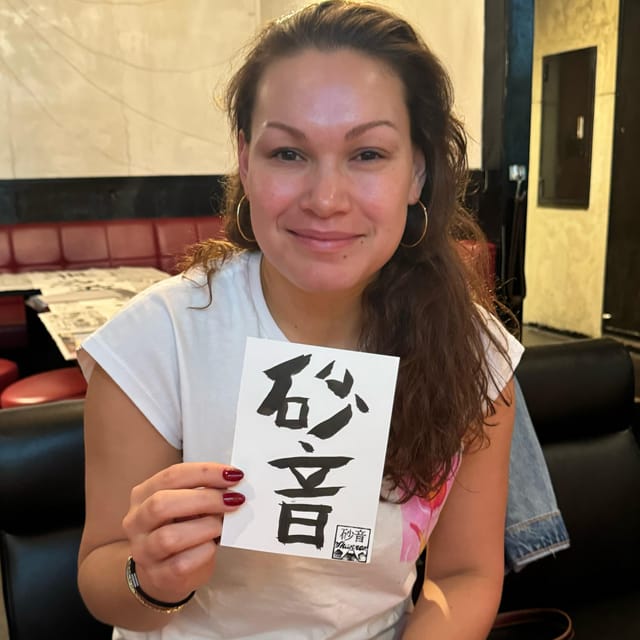
A brush can feel slippery and unpredictable at first. Here are ways to improve your odds quickly without overthinking:
- Choose a kanji you genuinely want to keep. Your name is the most satisfying option because it anchors the workshop.
- Relax your grip before you begin the first stroke. Tension makes your lines wobble.
- Treat practice attempts like part of the final piece. The instructors guide you, and you improve faster after you see what to correct.
- Think stroke order, not just the character. Japanese calligraphy is about sequence, direction, and lift.
- Be ready to accept a learning curve. Even when you are careful, you will likely feel awkward for the first few tries.
If you are traveling with kids, this kind of activity can be a win because it is creative, personal, and tangible. Just be aware that it is still a real workshop, so calm attention helps.
Should you book Shodo Cafe 7557 in Roppongi?
Yes, you should book it if you want a peaceful, practical cultural experience that gives you real keepsakes. This is the rare kind of activity where you leave with your own artwork, a personalized stamp, and a bundle of kanji-themed items—all built around learning basic brush control.
I would skip it only if you want a low-structure experience or you dislike making multiple hands-on items in a limited time window. If you are okay slowing down for a focused hour, this workshop is an easy choice.
FAQ
How long is the calligraphy workshop?
The duration is listed as 80 minutes. You should expect the activity to last between 60 minutes and 2 hours.
Where is the meeting point?
You meet at Shodo Cafe 7557 in the Crest Roppongi Building, 2nd floor. From Roppongi Station (Toei Oedo Line, Exit 7), cross toward FamilyMart, turn right toward the National Art Center, walk along Bijutsukan Dori, and look for the large crane sign.
What language are the instructions in?
Instruction is available in English.
What can I write on the fan and hanging scroll?
You can write your name or a favorite word in kanji. You will receive guidance on choosing and creating what you want.
Do I get to make a hanko stamp?
Yes. You create a hiragana hanko stamp of your name to take home.
What drinks are included?
The included drink options are matcha latte, green tea, coffee, soda, or beer.
What souvenirs will I take home?
You take home your kakejiku (hanging scroll) and uchiwa (paper fan), plus a personalized hanko stamp. You also receive kanji items such as a kanji tote bag, kanji keychain, kanji coaster, and kanji pouch.
Can I book and pay later?
Yes. The listing states reserve now & pay later.
Is free cancellation available?
Yes. You can cancel up to 24 hours in advance for a full refund.
Is this activity wheelchair accessible?
The activity is listed as wheelchair accessible.
Is there an age limit?
It is listed as not suitable for people over 95 years.
More Tour Reviews in Tokyo
- Mt Fuji and Hakone 1-Day Bus Tour Return by Bullet Train
★ 5.0 · 26,383 reviews - 1-Day Tokyo Bus Tour
★ 5.0 · 14,250 reviews - Tokyo: teamLab Planets TOKYO Digital Art Museum Entry Ticket
★ 4.6 · 9,779 reviews - Mt Fuji & Hakone Cruise, Drum Show Bullet Train 1 Day from Tokyo
★ 4.0 · 7,413 reviews - Tokyo: Shinjuku Food Tour (13 Dishes at 4 Local Eateries)
★ 5.0 · 6,603 reviews
More Artisan Workshops in Tokyo
- Tokyo Shinjuku Chopsticks Making Class
★ 5.0 · 1,763 reviews - Chopstick Making Workshop in Ginza
★ 4.8 · 1,366 reviews - Kintsugi Experience: Art of Golden Joinery in Tokyo
★ 5.0 · 467 reviews - Tokyo Chopstick Making Workshop with Artisan
★ 5.0 · 466 reviews - Tokyo: Shinjuku Chopstick Making Class
★ 4.9 · 440 reviews
Latest Tokyo reviews off our desk






Craft & Artisan Workshops, compared.
 ★ 5.0Tokyo Shinjuku Chopsticks Making ClassFrom $201,763 reviews
 ★ 4.8Chopstick Making Workshop in GinzaFrom $251,366 reviews
 ★ 5.0Kintsugi Experience: Art of Golden Joinery in TokyoFrom $59467 reviews
 ★ 5.0Tokyo Chopstick Making Workshop with ArtisanFrom $26466 reviews
 ★ 5.0Authentic Pure Gold Kintsugi Workshop with Master Taku in TokyoFrom $142217 reviews
 ★ 5.0Let’s experience calligraphy in YANAKA, Taito-ku, TOKYO !!From $75127 reviews
Browse the lists this tour appears in