
Reviewed · KAMAKURA DAY TRIPS
Kamakura Half Day Walking Tour with Local Experience
Kamakura feels closer with a plan. This half-day walking tour strings together the big sights—Hase-dera and the Great Buddha—with an easy ride along the Pacific on the Enoden train.
I like that the meeting point is clear and the guide handles the rail moves for you, starting from the Suica Penguin Plaza in Shinjuku and using the Enoshima & Kamakura Freepass for unlimited Enoden rides during the tour.
My second favorite part is the time you actually get at each stop: guided exploration at Hase-dera, then an in-person moment in front of the Great Buddha at Kotoku-in, plus a Komachi Street break and a guided stop at Tsurugaoka Hachiman-gu. One caution: this is not a couch-potato half day—you walk about 3 km total, and you’ll want to follow the rules (no large bags, short skirts, or photos inside), plus there’s a real chance of missing the meeting point if you don’t confirm with the WhatsApp contact/call.
In This Review
- Key moments that make this tour work
- From Suica Penguin Plaza to the Enoden coast train
- How the transport plan keeps you from wasting time
- Hase-dera: temple of flowers with caves and bay views
- Kotoku-in’s Great Buddha: your 20-minute time window
- Back on the Enoden, then Kamakura’s Komachi-dori break
- Tsurugaoka Hachiman-gu: samurai-era context in a short guided stop
- Price and value: what $83 really buys you
- Walking, rules, and what to wear so you enjoy it
- Optional experiences for your afternoon reset
- Should you book this Kamakura half day walking tour?
- FAQ
- Where is the meeting point in Shinjuku?
- What trains are included to get to Kamakura?
- What is the Enoshima & Kamakura Freepass used for?
- Is entrance to Hase-dera and Kotoku-in included?
- What about food and lunch?
- Is photography allowed inside the temples?
Key moments that make this tour work
- Shinjuku meetup with a specific landmark: Suica Penguin Statue area at Suica Penguin Plaza (2nd floor of the bus terminal annex).
- Unlimited Enoden rides with the Freepass: you’re on the coastal line more than once without guessing schedules.
- Hase-dera’s mix of scenery and structure: garden areas, caves, Buddhist halls, and a bay-view terrace.
- Kotoku-in in the flesh: enough time to really look at the Great Buddha details.
- Komachi Street snack break + Tsurugaoka Hachiman-gu: classic Kamakura flavor, then a short guided history stop.
From Suica Penguin Plaza to the Enoden coast train
The day starts in Shinjuku, meeting your guide at the Suica Penguin Statue on the pedestrian deck called Suica Penguin Plaza. It’s on the 2nd floor of the Shinjuku Expressway Bus Terminal Building annexed to JR Shinjuku Station, and it’s also reachable from the new south gate.
You’ll gather, then walk about 5 minutes to the Odakyu Line area for the train toward Fujisawa. Once you’re en route, you stop having to think about transfers, which matters a lot when you’re trying to enjoy a short visit instead of solving transit puzzles.
This tour runs in English and Spanish, and you can book private or small groups. That’s useful if you want the guide to move at a human pace and answer questions without feeling rushed.
Coast-and-Buddha days near Kamakura, rated
- Tokyo: Kamakura & Enoshima Day Trip including Temple Tickets
★ 4.5 · 1,375 reviews - From Tokyo: Kamakura & Enoshima 1-Day Bus Tour
★ 4.5 · 189 reviews - Kamakura Historical Walking Tour with the Great Buddha
★ 5.0 · 129 reviews - Kamakura Private Tour: Temples, Nature, and the Great Buddha
★ 5.0 · 121 reviews
How the transport plan keeps you from wasting time
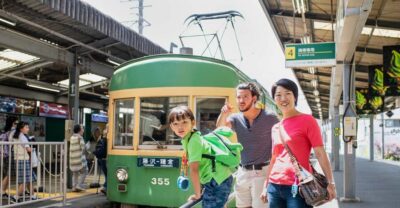
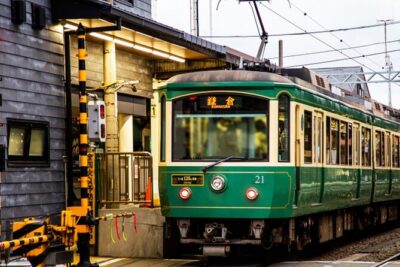
There are two parts to the ride: Odakyu to Fujisawa, then the Enoden train along the coast. The Enoden is the star here because it’s the popular coastal rail line, and you’ll use it more than once during your half day.
You also get the Enoshima & Kamakura Freepass, described as a day pass with unlimited rides on all Enoden trains until the tour ends. That means you can focus on windows, photos outside, and short walk transitions—rather than worrying whether you’re on the correct exact train.
The tour includes a return transportation ticket from Shinjuku via the Odakyū Kamakura-Enoshima Pass, so you’re not stuck paying extra just to get home. One practical note: the itinerary includes a total train time of about 110 minutes, plus a short additional Enoden hop later in the day.
Hase-dera: temple of flowers with caves and bay views
Your first major stop is Hase-dera, often called the temple of flowers. You get a guided visit for about 45 minutes, which is a good amount of time for a place that has layers. You’re not just ticking boxes—you’re guided through the garden areas, Buddhist halls, cave spaces, and then up to a panoramic terrace overlooking the bay.
This mix is why Hase-dera works well on a half-day tour. Gardens give you a visual break from train travel, caves add a sense of change in atmosphere, and the bay terrace is your payoff moment—when you can finally look out and see why Kamakura draws people in the first place.
A small practical expectation: you’ll be moving between areas, and the rules say photography inside is not allowed. So I’d treat this stop like a look-and-listen experience first, not a photo scavenger hunt.
In the more positive guide stories, the tour staff names show up as Silvy and Romy. Both are described as patient and very good at explaining what you’re seeing, and that’s exactly the kind of skill that turns Hase-dera from a pretty stop into a memorable one.
Kotoku-in’s Great Buddha: your 20-minute time window
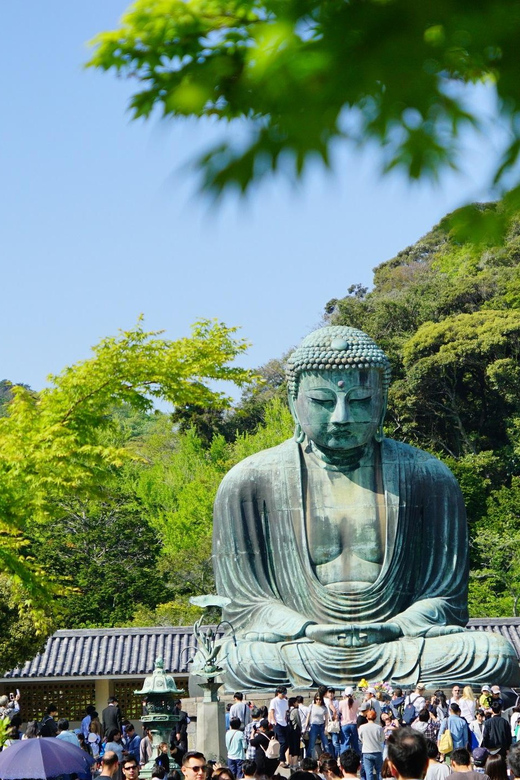
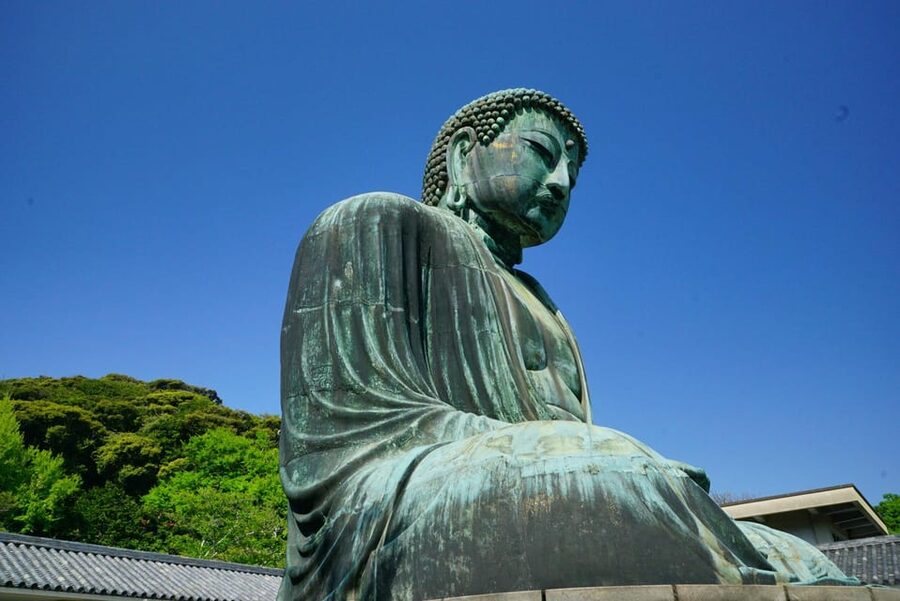
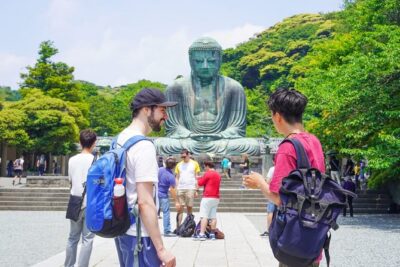
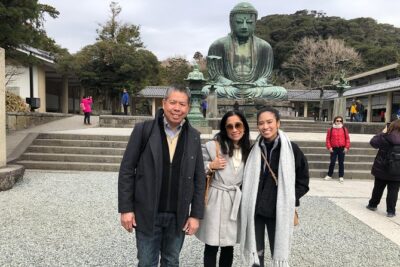
Next you head to Kōtoku-in Temple, where the famous Great Buddha sits. You’ll have about 20 minutes for your visit, with a short walk connection between the stops.
This is the moment most people come for, so the timing matters. Twenty minutes is enough to get oriented, notice the statue’s presence from multiple angles, and absorb the details you might miss when you only have five minutes. You’ll likely feel that quiet wow-factor standing there—it’s the kind of site where you can let your brain slow down.
Again, the photography restriction applies inside. If you want photos, plan to rely on outdoor views and the area around the main viewing space. The point here is what you experience in person, not getting a perfect shot.
If Hase-dera is about variety of spaces, Kotoku-in is about focus. Two stops, two different tempos, and the guide’s job is to help you see both without rushing you through either.
Back on the Enoden, then Kamakura’s Komachi-dori break
After Kotoku-in, you ride the Enoden once more to reach Kamakura Station, then walk into the center of town. You’ll spend about 20 minutes at Komachi-dori Street (Komachi Dori / Komachi Street), which is where the day turns from temples to street life.
You’ll also get a snack or beverage included, up to 500 JPY per person, so you don’t have to make decisions at the worst possible moment—right when you’re hungry. This is a smart inclusion for a half-day itinerary because lunch isn’t provided, and you still want something to carry you through the afternoon.
Komachi-dori is the kind of place where your senses take over. It’s easy to drift, so I recommend using the time with intention: pick one snack, pause for a quick look at the storefront rhythm, and then head toward Tsurugaoka Hachiman-gu while you still feel fresh.
Readers also shortlisted these Kamakura bookings:
- Kamakura Walking Tour – The City of Shogun★ 5.0 · 100 reviews
- Buddha, Bamboo & Zen – Bespoke Kamakura Private Walking Tours★ 5.0 · 25 reviews
- Kamakura: Walking Tour through the City of Samurai★ 4.9 · 12 reviews
- Kamakura: Half day Walking tour & Japanese sweets★ 5.0 · 11 reviews
- Kamakura Heritage Bike or Walk Tour with ex-Rickshaw guide★ 5.0 · 11 reviews
Tsurugaoka Hachiman-gu: samurai-era context in a short guided stop
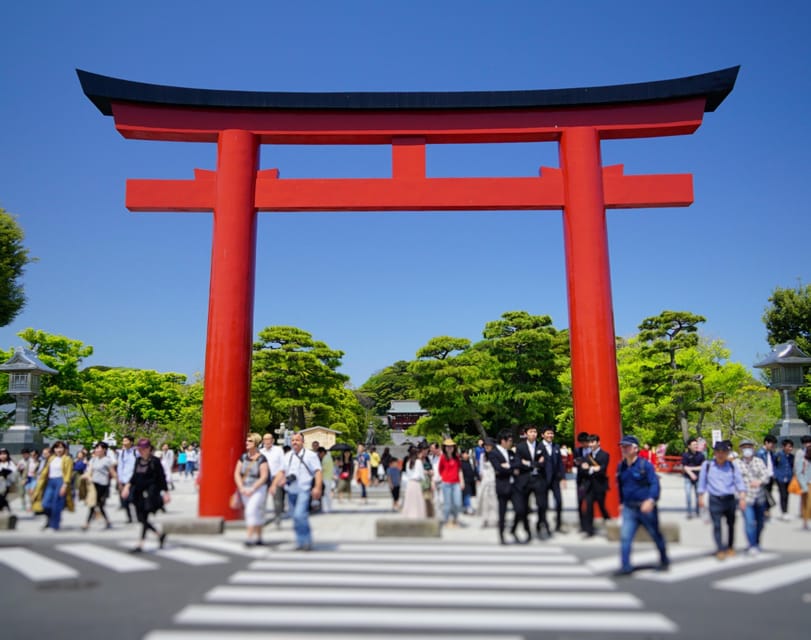
The tour ends with a guided stop at Tsurugaoka Hachiman-gu, roughly 20 minutes. You’ll walk there from Komachi Street area and see the shrine dedicated to the deity of war.
What I like about this final piece is the historical translation. Temples are one thing, but the guide connects the shrine to Kamakura’s samurai past, so your half day doesn’t feel like a random list of stops. Even with limited time, that context helps you read the city better after the tour ends.
This is also where the tour becomes flexible. You finish at the shrine, and then you’re free to spend the afternoon in Kamakura on your own. If you’ve only got a half day, this kind of exit is ideal—you get the anchor sights first, then choose how slow or adventurous you want to be afterward.
Price and value: what $83 really buys you
At $83 per person, the value depends on what you’d otherwise pay for on your own. Here, the tour bundles an English-speaking guide for the Tokyo-to-Kamakura routing, temple entrances for Hase-dera and Kōtoku-in, and transportation elements including the rail passes and return ticketing described in the inclusions.
You also get the snack or beverage credit (up to 500 JPY), which helps close the gap since lunch is not included. So if you’re comparing against “just trains + admission,” this package can be easier—especially because it saves time and mental load.
The duration is listed as 330 minutes (about 5.5 hours), which is a very workable half-day frame for first-time visitors. It’s long enough to feel like you saw a real slice of Kamakura, yet short enough that you can still enjoy an afternoon wandering without fatigue crashing your energy.
One more practical angle: the tour includes private or small group options. That can be a big deal in Japan when crowded trains and popular sites can turn into stop-and-go frustration. Smaller groups tend to make transitions smoother.
Walking, rules, and what to wear so you enjoy it
This tour involves about 3 km of walking total, and it’s not marked as suitable for low fitness levels. That doesn’t mean it’s extreme, but it does mean you should wear shoes that handle stairs and uneven temple paths.
In summer, the guidance says to bring plenty of water, a wipe, and possibly a change of clothes due to heat and humidity. That’s not a throwaway tip—temples + outdoor transitions can drain you faster than expected.
You’ll also want to plan around the rules listed for the tour:
- no luggage or large bags
- no short skirts
- no loose clothing
- photography inside is not allowed
If you’re traveling with a day bag, keep it compact. You’ll enjoy the day more if your hands are free and you’re not doing awkward bag management in crowded stations.
Wheelchair accessibility is listed, which is helpful to know. The tour includes paths and train segments, so it’s still smart to confirm practical comfort needs with the operator before you go, but accessibility is explicitly considered.
Optional experiences for your afternoon reset
After Tsurugaoka Hachiman-gu, you’re on your own for the rest of the day, with the option to choose local experiences. The exact options aren’t spelled out here, so I can’t promise what’s available when you book.
Still, the structure is good for planning: you’ve already hit the high-signal sights, then you can pick what matches your mood—more sightseeing, more street time, or a slower pace to soak up Kamakura at your own tempo.
If you’re the type who likes “anchor sites plus freedom,” this format usually works well.
Should you book this Kamakura half day walking tour?
Book it if you want a guided, efficient Kamakura intro with the Enoden coastal train ride included, plus real time at Hase-dera and Kotoku-in. It’s also a strong fit if you’d rather not map train timing and station exits alone for a short trip.
I’d think twice if you dislike walking around temple areas, if your fitness level is limited, or if you’re counting on lots of indoor photos. Also, do not wing the meetup—make sure your WhatsApp contact works, and be reachable for calls if the guide can’t find you.
Finally, if you care about how a tour feels, the best guide notes include Silvy (patient and on time, with thoughtful follow-through) and Romy (knowledgeable and adaptable). That’s the kind of human attention that turns Kamakura from a checklist into something you remember.
FAQ
Where is the meeting point in Shinjuku?
Meet in front of the Suica Penguin Statue at Suica Penguin Plaza on the second floor of the Shinjuku Expressway Bus Terminal Building annexed to JR Shinjuku Station.
What trains are included to get to Kamakura?
You take the Odakyu line from Shinjuku toward Fujisawa, then ride the Enoden (Enoshima Electric Railway) to the Kamakura area along the coast. You’ll use the Enoden again during the tour.
What is the Enoshima & Kamakura Freepass used for?
It’s a day pass included with the tour that allows unlimited rides on Enoden trains until the tour ends.
Is entrance to Hase-dera and Kotoku-in included?
Yes. Entrances to Hase-dera and Kōtoku-in Temple are included.
What about food and lunch?
A local snack or beverage of your choice up to 500 JPY per person is included. Lunch is not included.
Is photography allowed inside the temples?
No. Photography inside is not allowed during this tour.
More Tours in Kamakura
- From Tokyo: Kamakura & Enoshima 1-Day Bus Tour
★ 4.5 · 189 reviews - Kamakura Historical Walking Tour with the Great Buddha
★ 5.0 · 129 reviews - Kamakura Private Tour: Temples, Nature, and the Great Buddha
★ 5.0 · 121 reviews - Kamakura Walking Tour – The City of Shogun
★ 5.0 · 100 reviews - Kamakura: Private Guided Walking Tour with Local Guide
★ 4.8 · 60 reviews
More Tour Reviews in Kamakura
- Tokyo: Kamakura & Enoshima Day Trip including Temple Tickets
★ 4.5 · 1,375 reviews - From Tokyo: Kamakura & Enoshima 1-Day Bus Tour
★ 4.5 · 189 reviews - Kamakura Historical Walking Tour with the Great Buddha
★ 5.0 · 129 reviews - Kamakura Private Tour: Temples, Nature, and the Great Buddha
★ 5.0 · 121 reviews - Kamakura Walking Tour – The City of Shogun
★ 5.0 · 100 reviews
More Kamakura and Enoshima Days
- Tokyo: Kamakura & Enoshima Day Trip including Temple Tickets
★ 4.5 · 1,375 reviews - From Tokyo: Kamakura & Enoshima 1-Day Bus Tour
★ 4.5 · 189 reviews - Kamakura Historical Walking Tour with the Great Buddha
★ 5.0 · 129 reviews - Kamakura Private Tour: Temples, Nature, and the Great Buddha
★ 5.0 · 121 reviews - Kamakura Walking Tour – The City of Shogun
★ 5.0 · 100 reviews
Latest Kamakura reviews off our desk
Kamakura Day Trips, compared.
 ★ 4.5Kamakura & Enoshima Day Trip including Temple TicketsFrom $581,375 reviews
 ★ 4.5Mt. Fuji, Kamakura, Big Buddha, & Lake Ashi Day TripFrom $49867 reviews
 ★ 4.5From Tokyo: Kamakura & Enoshima 1-Day Bus TourFrom $66189 reviews
 ★ 5.0Kamakura Historical Walking Tour with the Great BuddhaFrom $98129 reviews
 ★ 5.0Kamakura Private Tour: Temples, Nature, and the Great BuddhaFrom $98121 reviews
 ★ 5.0Kamakura Walking Tour – The City of ShogunFrom $35100 reviews
 ★ 4.9Sea of Mount Fuji, Hakone Ropeway, Ōwakudani, EnoshimaFrom $5084 reviews
 ★ 5.0Kamakura 8 hr Private Walking Tour with Licensed Guide from TokyoFrom $20180 reviews
Browse the lists this tour appears in